

중국에서 의류를 수입할 때 잘못된 배송 방법을 선택하면 수천 달러의 비용이 발생하거나 가장 바쁜 판매 기간에 품절이 발생할 수 있습니다. 다음과 같은 뉘앙스를 이해해야 합니다. 중국에서 배송 는 비용, 배송 시간, 재고 관리를 최적화하는 데 필수적입니다.
많은 의류 브랜드 소유주들은 장단점을 이해하지 못한 채 공장에서 제안하는 배송 방법을 그대로 사용합니다. 이러한 소극적인 접근 방식은 종종 해상으로 배송할 수 있는 화물에 대해 특급 요금을 지불하거나 항공 화물을 이용하면 재고 부족 위기를 방지할 수 있는데도 몇 주 동안 해상 운송을 기다리는 결과를 초래합니다.
이 종합 가이드에서는 모든 주요 기능을 세분화하여 설명합니다. 중국에서 배송 의류 수입에 대한 옵션. 항공 운송, 해상 운송 또는 특송 서비스를 언제 사용해야 하는지, 실제 배송비를 계산하는 방법, 수익성을 극대화하기 위해 물류 전략을 최적화하는 방법을 정확하게 배울 수 있습니다.
이 가이드에서 마스터할 내용:
- 항공 화물, 해상 화물 및 특송 배송에 대한 완벽한 비교
- 숨겨진 수수료가 포함된 실제 비용 계산
- 목적지별 환승 시간 비교
- 특정 상황에 적합한 배송 방법을 선택하는 방법
- 화물 운송업체 선정 및 관리
- 통관 필수품
- 보험 및 위험 관리
- 배송비 절감을 위한 팁
목차
중국발 배송 방법 개요
계획할 때 중국에서 배송 의류 주문에는 각각 다른 장점과 비용, 이상적인 사용 사례를 가진 세 가지 기본 옵션이 있습니다.
세 가지 주요 배송 방법
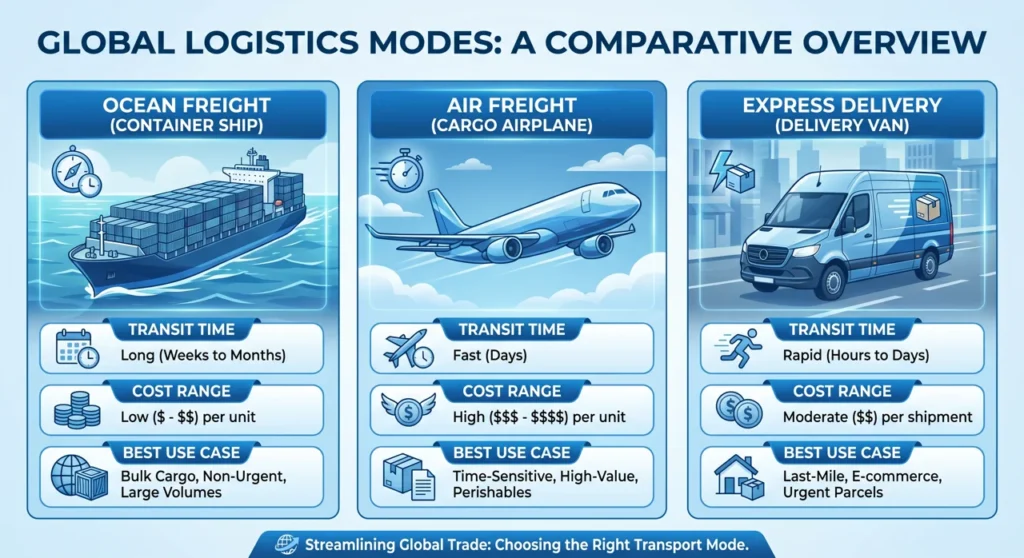
해상 화물(해상 운송):
- 최상의 대상: 대량 배송(500kg 이상), 긴급하지 않은 재고
- 이동 시간: 20~40일
- 비용: 입방미터(CBM) 당 $300-800
- 최고의 가치: 속도보다 비용이 더 중요한 대량 주문
항공 화물:
- 최상의 대상: 중간 배송(100-500kg), 시간에 민감한 재고
- 이동 시간: 5~10일
- 비용: kg당 $4-8
- 최고의 가치: 해상보다 빠른 배송이 필요한 중간 규모 주문
특급 배송(DHL, FedEx, UPS):
- 최상의 대상: 소형 배송(100kg 미만), 긴급 배송
- 이동 시간: 3~7일
- 비용: $6-12 kg당
- 최고의 가치: 샘플, 소액 주문, 긴급 재고
빠른 의사 결정 가이드
해상 운송 시기를 선택합니다:
- 주문량은 500kg 이상 또는 2입방미터 이상입니다.
- 배송까지 3~6주를 기다릴 수 있습니다.
- 속도보다 중요한 것은 비용
- 다음 시즌 재고를 주문하는 중입니다.
항공 화물 시기를 선택합니다:
- 주문량은 100-500kg입니다.
- 2주 이내에 배송해야 합니다.
- 높은 배송비를 흡수할 수 있는 마진이 좋은 제품
- 빠르게 재고가 소진되는 품목을 재입고하는 경우
익스프레스 시기를 선택합니다:
- 주문량이 100kg 미만인 경우
- 1주일 이내에 배송해야 합니다.
- 샘플 주문 또는 긴급 재입고입니다.
- 비용보다 중요한 것은 시간
배송 인코텀즈 이해
배송 방법을 비교하기 전에 누가 무엇을 지불하는지를 정의하는 국제 상거래 용어인 인코텀즈를 이해해야 합니다:
FOB(선상 무료):
- 공장에서 항구로 상품을 배송하고 선박에 적재합니다.
- 해상 운송비, 보험료 및 목적지 비용은 고객이 부담합니다.
- 해상 운송에 가장 일반적
CIF(비용, 보험, 운임):
- 공장에서 목적지 항구까지의 배송비를 지불합니다.
- 목적지 항구 수수료, 세관 및 배송비를 지불합니다.
- 더 비싸지만 더 간단합니다.
EXW(Ex Works):
- 공장에서 픽업을 예약합니다.
- 가장 많은 권한과 가장 많은 책임
- 일반적으로 매우 큰 규모의 기업에만 해당됩니다.
DDP(관세지급반입인도조건):
- 공장에서 문 앞까지 배송, 모든 비용 지불
- 가장 비싸지만 가장 간단한 방법
- 단순함을 원하는 소규모 브랜드에 적합
추천합니다: 해상 운송의 경우 FOB 조건(배송 관리)으로 시작하거나 항공/특급 배송의 경우 DDP 조건(간편함)으로 시작하세요. 경험이 쌓이면 최적화할 수 있습니다.
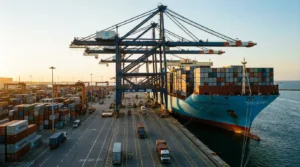
이미지 1: 배송 방법 개요 컨테이너선(해상), 화물기(항공), 특급 배송 트럭의 세 가지 배송 방법을 나란히 비교하여 시각적으로 보여줍니다. 일반적인 운송 시간, 비용 범위, 이상적인 배송 크기 등 각각의 주요 통계가 포함되어 있습니다.
해상 화물(해상 운송)
해상 운송은 다음과 같은 경우에 가장 경제적인 옵션입니다. 중국에서 배송 시간적 여유가 있을 때 사용할 수 있습니다.
해상 운송의 작동 방식
프로세스:
- 공장에서 중국 항구로 상품을 배송(FOB)하거나 고객이 픽업(EXW)을 주선합니다.
- 상품이 배송 컨테이너에 적재됩니다.
- 선박에 적재된 컨테이너
- 목적지 항구까지 해상 운송(15~30일)
- 목적지에서 컨테이너 하역
- 통관 및 검사
- 창고 또는 물류 센터로 배송
컨테이너 유형:
FCL(전체 컨테이너 적재량):
- 20피트 또는 40피트 컨테이너 전체를 임대하는 경우
- 20피트 컨테이너: ~28 CBM 용량, 최대 20,000kg
- 40피트 컨테이너: ~58 CBM 용량, 최대 25,000kg
- 컨테이너의 대부분을 채울 수 있을 만큼 상품이 충분할 때 가장 좋습니다.
LCL(컨테이너 적재량 미만):
- 상품이 다른 발송물과 컨테이너를 공유합니다.
- 사용한 공간에 대해서만 비용을 지불합니다(CBM당).
- 최소 요금: 일반적으로 1 CBM
- 컨테이너를 가득 채우지 않는 소규모 배송에 적합
해상 운송 비용
기본 해상 운임(2026년 추정치):
FCL 요금(전체 컨테이너):
- 20피트 컨테이너: 목적지에 따라 $1,000~2,500달러
- 40피트 컨테이너: $1,500~4,000달러(목적지에 따라 다름)
- 성수기(7월~10월): +20-40%
- 비수기: 표준 요금 또는 할인
LCL 요금(입방미터당):
- 표준 요금: CBM당 $50-150
- 최소 요금: 1 CBM (0.5 CBM을 배송하는 경우에도)
- 밀도 계수: 무거운 상품은 부피가 아닌 무게로 요금이 부과될 수 있습니다.
추가 해상 운송 비용:
출발지 요금(중국):
- 통관: $100-200
- 포트 처리: $100-300
- 문서 $50-150
- 컨테이너 적재: $100-200
- 총 원산지: $350-850
목적지 요금(해당 국가):
- 포트 처리: $200-500
- 통관: $150-400
- 문서 $100-200
- 컨테이너 하역: $150-300
- 창고로 배송: $200-800
- 총 목적지: $800-2,200
기타 잠재적 비용:
- 관세 및 세금(제품 및 국가에 따라 다름)
- 검사 수수료(세관에서 검사 대상으로 선정한 경우)
- 보관 수수료(컨테이너가 항구에 너무 오래 머무는 경우)
- 반송료(컨테이너를 제시간에 반납하지 않은 경우)
총 해상 운송비 예시:
배송: 의류 5 CBM(500kg)
노선: 광저우~로스앤젤레스
해상 화물(LCL): 5 CBM × $80 = $400
원산지 요금: $500
목적지 요금: $1,200
통관: $300
의무(15% 가정): $450
총 배송비: $2,850
kg당 비용: $5.70
개당 비용(500개 품목의 경우): $5.70
해상 화물 운송 시간
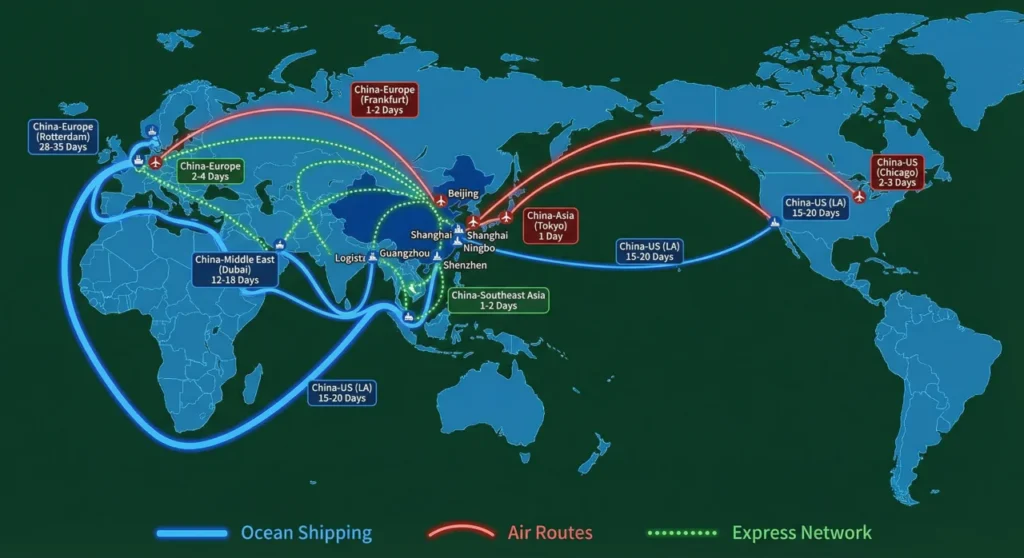
일반적인 환승 시간:
미국으로:
- 서부 해안(로스앤젤레스, 롱비치): 14-18일
- 동부 해안(뉴욕, 사바나): 28~35일
- 파나마 운하 경유: 24~30일
유럽으로:
- 영국(펠릭스토우, 사우샘프턴): 25~30일
- 독일(함부르크): 28~32일
- 네덜란드(로테르담): 26~30일
호주로:
- 시드니/멜버른: 18~22일
- 브리즈번: 16~20일
- 퍼스: 12~16일
다른 목적지로:
- 중동: 18~25일
- 남미: 30~45일
- 아프리카: 25~40일
환승 시간에 영향을 미치는 요인:
- 항만 혼잡(2021~2022년 주요 문제, 현재 개선 중)
- 날씨 조건
- 환적(중간 항구에서 선박 간 이동)
- 통관 지연
- 선박 스케줄링
해상 운송의 장단점
장점:
- ✅ 대량 배송의 경우 kg당 최저 비용
- ✅ 공기보다 환경 친화적
- ✅ 대량 배송 가능
- ✅ 항공보다 낮은 유류할증료
- ✅ FCL은 보안을 제공합니다(컨테이너, 잠금 장치).
단점:
- 느린 배송 시간(3~6주) ❌ 느린 배송 시간(3~6주)
- 예측하기 어려운 배송 날짜
- 항만 혼잡으로 인해 몇 주가 추가될 수 있습니다.
- 의류 습기 손상 위험 ❌ 의류 손상 위험
- ❌ 더 많은 재고 계획 필요
해상 운송 이용 시기
최상의 대상:
- 500kg 또는 2CBM 이상 주문
- 긴급하지 않은 재고(2개월 이상 미리 계획)
- 대량 생산, 저마진 제품
- 표준 재고의 정기적 보충
- 시즌 재고(시즌 3~4개월 전 주문)
Not For:
- 긴급 주문
- 고가, 저중량 품목(항공이 더 저렴할 수 있음)
- 시간에 민감한 패션(유행이 지나갈 수 있음)
- 소규모 테스트 주문(최소 LCL로 인해 비용이 많이 듦)
항공 화물
항공화물은 다음을 위한 중간 지점을 제공합니다. 중국에서 배송-해상보다 빠르지만 대규모 배송의 경우 특송보다 경제적입니다.
항공 화물 작동 방식
프로세스:
- 공장에서 공항 또는 화물 운송업체 창고로 상품 배송
- 다른 발송물과 통합된 상품(LCL 항공의 경우)
- 중국에서의 보안 검색 및 통관
- 목적지 공항으로 가는 항공편
- 목적지에서의 통관
- 시설로 배송
항공 화물 대 특송:
- 항공 화물: 공항 간 운송(픽업 처리)
- 에어 익스프레스: 집집마다 배송(택배가 모든 것을 처리)
- 무거운 화물의 경우 항공 운송이 더 저렴합니다.
- Express는 더 간단하지만 더 비쌉니다.
항공 화물 비용
기본 항공 운임(2026년 추정치):
표준 항공 화물:
- $4.00-6.00 kg당(100kg 초과)
- $6.00-8.00 kg당(45-100kg)
- 최소 요금: 45kg(30kg 배송 시에도)
- 요금은 노선, 계절 및 연료 가격에 따라 다릅니다.
공항 대 공항, 집 대 집:
- 공항 간 이동: 기본 요금만 적용
- 집집마다: 픽업 및 배송의 경우 kg당 $1-2 추가
추가 항공 운송 비용:
오리진 요금:
- 공항 취급: $0.30-0.50 kg당
- 통관: $50-150
- 보안 검사: kg당 $0.10-0.20
- 문서 $50-100
목적지 요금:
- 공항 취급: $0.30-0.50 kg당
- 통관: $100-300
- 픽업/배달: $50-200
유류할증료:
- 유가에 따라 변동 가능
- 일반적으로 kg당 $0.50-2.00
- 월별 또는 분기별 업데이트
보안 추가 요금:
- 9/11 테러 이후 보안 비용
- 일반적으로 kg당 $0.10-0.30
총 항공 운임 비용 예시:
배송: 의류 200kg
노선: 광저우~로스앤젤레스
기본 항공 화물: 200kg × $5.00 = $1,000
유류할증료: 200kg × $1.00 = $200
보안 할증료: 200kg × $0.20 = $40
원산지 요금: $150
목적지 요금: $250
통관: $150
총 배송비: $1,790
kg당 비용: $8.95
항공 화물 운송 시간
일반적인 환승 시간:
미국으로:
- 주요 도시(LAX, JFK, ORD): 3~5일
- 보조 도시: 5~7일
- 비행 시간 및 통관 포함
유럽으로:
- 주요 허브(런던, 프랑크푸르트, 암스테르담): 3~5일
- 보조 도시: 5-8일
호주로:
- 시드니/멜버른: 2-4일
- 기타 도시: 4-6일
다른 목적지로:
- 중동: 3~5일
- 남미: 5~7일
- 아프리카: 4~6일
환승 시간에 영향을 미치는 요인:
- 항공편 이용 가능 여부 및 노선
- 통합 시간(LCL의 경우)
- 통관 속도
- 주말/공휴일 지연
- 날씨
항공화물의 장단점
장점:
- ✅ 빠른 배송(총 3~7일)
- ✅ 바다보다 더 안정적인 스케줄
- ✅ 취급 감소(손상 위험 감소)
- ✅ 중간 중량 배송에 적합
- ✅ 시간에 민감한 재고에 더 적합
단점:
- 비싸다(해상 운송 비용의 4~10배)
- ❌ 체중 제한
- 높은 유류 할증료
- ❌ 크고 무거운 배송에는 비용 효율적이지 않음
- 탄소 발자국 우려
항공화물 이용 시기
최상의 대상:
- 배송 100-500kg
- 빠르게 이동하는 품목 재입고
- 배송비를 관리할 수 있는 고마진 제품
- 시간에 민감한 재고
- 신제품 테스트(신속한 시장 피드백)
Not For:
- 매우 무거운 배송(500kg 이상, 해상 배송이 더 저렴함)
- 마진이 낮은 제품(배송비가 모든 수익을 잠식함)
- 긴급하지 않은 재고
- 대량 정기 주문
특급 배송(DHL, FedEx, UPS)
특급 택배 서비스는 가장 간단하고 빠른 중국에서 배송 소규모 배송 및 긴급한 요구사항에 대한 옵션입니다.
특급 배송의 작동 방식
프로세스:
- 공장에서 상품 포장 및 픽업 요청
- 공장에서 택배 픽업
- 택배가 모든 서류와 세관을 처리합니다.
- 상품은 다음 이용 가능한 항공편으로 배송됩니다.
- 도착지에서 택배가 세관을 통과합니다.
- 택배가 집 앞까지 배달
- 배송 시 관세/세금을 지불하거나 계좌로 청구합니다.
단순성: 특급 배송은 집집마다 배송됩니다. 택배가 처리합니다:
- 공장에서 픽업
- 수출 통관
- 항공 운송
- 수입 통관
- 주소지로 배송
- 전체 추적
특급 배송 비용
기본 특급 요금(2026년 예상치):
중국에서 출발하는 DHL/FedEx/UPS:
- 문서(1kg 미만): $40-80
- 소형 패키지(1-5kg): $60-150
- 중형 패키지(5-21kg): kg당 $8-12
- 대형 발송물(21-70kg): kg당 $6-10
- 70kg 이상: kg당 $5-8
추가 특송 비용:
유류할증료:
- 기본 요율의 15-25%
- 연료 가격을 기준으로 매주 업데이트
- 중요한 비용 구성 요소
원격 지역 추가 요금:
- 배송 주소가 주요 대도시 외 지역인 경우
- $20-40 추가
- 주소가 해당되는지 택배사에 확인하세요.
거주지 배송:
- $3-5 가정 배송 시 추가 요금(비즈니스용 대비)
- 일부 택배는 기본 요금에 포함됩니다.
확장 지역 추가 요금:
- 매우 외진 위치의 경우
- $20-100 추가 가능
관세 및 세금:
- 배송 견적에 포함되지 않음
- 배송 시 수취인이 결제
- 또는 계정이 있는 경우 계정으로 청구합니다.
총 특급 비용 예시:
배송: 의류 샘플 25kg
서비스: DHL Express Worldwide
노선: 광저우 - 뉴욕
기본 요금: 25kg × $9.00 = $225
유류할증료(20%): $45
외딴 지역: $0(지하철 배송)
총 배송비: $270
관세/세금(예상치): $40
총 배송 비용: $310
kg당 비용: $12.40
빠른 배송 시간
DHL Express:
- 전 세계: 2~5일
- 주요 도시: 2~3일
- 외딴 지역: 4~6일
FedEx 국제 특급 배송:
- 전 세계: 2~4일
- 주요 도시: 2~3일
- 외딴 지역: 3~5일
UPS Worldwide Express:
- 전 세계: 2~5일
- 주요 도시: 2~3일
- 외딴 지역: 4~6일
중요 참고 사항: 배송 시간은 영업일 기준이며 제외됩니다:
- 수령일
- 통관 지연
- 주말/공휴일 지연
- 원격 지역 배송 시간
특급 배송의 장단점
장점:
- ✅ 가장 빠른 옵션(2~5일)
- ✅ 방문 서비스
- ✅ 간소화된 통관 절차
- ✅ 뛰어난 추적 기능
- ✅ 샘플 및 소량 주문에 이상적
- ✅ 화물 운송업체 필요 없음
단점:
- ❌ 가장 비싼 옵션
- 대량 배송의 경우 비용 효율적이지 않음
- 높은 유류 할증료
- ❌ 무게 및 크기 제한
- ❌ 배송 시 징수되는 관세는 예상치 못한 비용이 될 수 있습니다.
특급 배송을 사용해야 하는 경우
최상의 대상:
- 샘플 및 프로토타입(20kg 미만)
- 긴급 재입고
- 고가, 저중량 품목
- 시간이 중요한 배송
- 새 공장으로 주문 테스트
- 단순함이 프리미엄의 가치가 있을 때
Not For:
- 일반 재고 주문(너무 비싸다)
- 무거운 배송물(70kg 이상, 항공 운송이 더 저렴)
- 비용에 민감한 제품
- 대량 주문
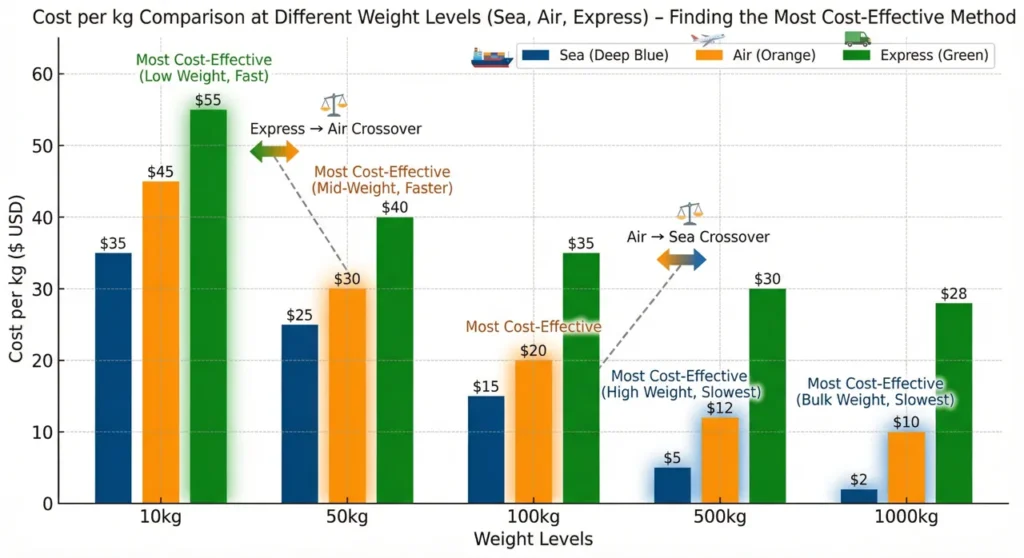
이미지 2: 배송비 비교 차트 다양한 무게(10kg, 50kg, 100kg, 500kg)에서 다양한 배송 방법의 비용을 비교하는 막대형 차트입니다. 각 방법의 중량에 따라 kg당 비용이 어떻게 변화하는지 보여줍니다. 한 방법이 다른 방법보다 유리해지는 교차점을 명확하게 시각적으로 보여줍니다.
비용 비교 및 계산
실제 비용 이해 중국에서 배송 기본 요금을 넘어 모든 수수료와 요금을 포함해야 합니다.
방법별 전체 비용 분석
배송 예시: 의류 100kg
해상 화물(LCL):
해상 화물(1 CBM 가정): $150
원산지 요금: $400
목적지 요금: $1,000
통관: $250
의무(15%): $300
합계: $2,100
kg당 비용: $21.00
배송 시간: 25~30일
항공 화물:
기본 화물(100kg × $5.50): $550
유류할증료: $150
보안 추가 요금: $30
원산지 요금: $150
목적지 요금: $300
통관: $150
의무 $300
합계: $1,630
kg당 비용: $16.30
배송 시간: 5~7일
Express(DHL):
기본 요금(100kg × $7.00): $700
유류할증료(20%): $140
출발지/목적지: 포함
통관: 포함됨
의무 $300
합계: $1,140
kg당 비용: $11.40
배송 시간: 3-4일
100kg에 대한 분석: 이 시나리오에서는 실제로 특급 배송이 kg당 가장 저렴하고 가장 빠릅니다. 그러나 200kg 이상에서는 항공 화물이 더 경쟁력이 있고, 500kg 이상에서는 해상 화물이 비용 면에서 우위에 있습니다.
무게 기준 kg당 비용
해상 화물(LCL):
- 50kg: kg당 $40-60(최소 금액으로 인해 비싸다)
- 100kg: kg당 $20-30
- 200kg: kg당 $12-18
- 500kg: kg당 $6-10
- 1000kg: kg당 $4-6
- 5000kg(FCL): kg당 $2-4
항공 화물:
- 45kg(최소): kg당 $12-16
- 100kg: kg당 $8-12
- 300kg: kg당 $6-9
- 500kg: kg당 $5-7
- 1000kg: kg당 $4-6
Express:
- 1 kg: $60-100 per kg
- 10 kg: $15-25 per kg
- 25 kg: $12-18 per kg
- 50 kg: $10-15 per kg
- 70 kg: $8-12 per kg
주의해야 할 숨겨진 비용
Sea Freight Hidden Costs:
- Port congestion fees (during peak times)
- Chassis fees (for container transport)
- Peak season surcharges (August-October)
- Customs inspection fees (random inspections)
- Storage fees at port (if delayed pickup)
- Demurrage (late container return)
Air Freight Hidden Costs:
- Dimension weight pricing (if bulky but light)
- Remote area delivery
- Dangerous goods fees (if applicable)
- Reweighing fees
- Document correction fees
Express Hidden Costs:
- Residential delivery surcharge
- Address correction fees
- Extended area surcharges
- Saturday delivery fees
- Duties and taxes (often overlooked)
- Fuel surcharge fluctuations
Calculating Landed Cost
Landed Cost = Product Cost + Shipping + Insurance + Duties + Fees
Example Calculation:
Product Cost:
- 500 t-shirts at $6 each = $3,000
Shipping (Air Freight):
- 150 kg at $7.50 per kg = $1,125
- Origin/destination charges = $400
- Insurance (1% of value) = $30
Duties and Taxes:
- Duty (15% on $3,000) = $450
- Customs processing = $150
Total Landed Cost: $5,155
Landed Cost per Unit: $10.31
Why Landed Cost Matters:
- Sets your true inventory cost
- Determines pricing strategy
- Affects profit margins
- Compare total cost, not just product cost
환승 시간 비교
Understanding realistic 중국에서 배송 transit times helps you plan inventory and avoid stockouts.
Door-to-Door Transit Times
미국으로:
| 방법 | West Coast | East Coast | 참고 |
|---|---|---|---|
| 해상 화물 | 18-25 days | 30~40일 | Port to port + customs + delivery |
| 항공 화물 | 5~7일 | 6-8 days | Includes customs clearance |
| 익스프레스 | 3-4 days | 4-5 days | Door to door |
유럽으로:
| 방법 | UK | Germany | France | 참고 |
|---|---|---|---|---|
| 해상 화물 | 25-30 days | 28-32 days | 27-31 days | Via Rotterdam/Antwerp |
| 항공 화물 | 4-6 days | 4-6 days | 4-6 days | Via major hubs |
| 익스프레스 | 3~5일 | 3~5일 | 3~5일 | Door to door |
호주로:
| 방법 | Sydney | Melbourne | Brisbane | 참고 |
|---|---|---|---|---|
| 해상 화물 | 18-22 days | 19-23 days | 16-20 days | Direct routes available |
| 항공 화물 | 3~5일 | 3~5일 | 3~5일 | Quick due to proximity |
| 익스프레스 | 2-4일 | 2-4일 | 2-4일 | Very fast |
Factors That Delay Shipments
Common Delays:
Sea Freight:
- Port congestion (major issue during peak season)
- Weather delays
- Vessel scheduling changes
- Customs inspections
- Documentation errors
항공 화물:
- Flight cancellations/schedule changes
- Security screening delays
- Consolidation delays (if LCL)
- Customs holds
- 날씨
Express:
- 통관 지연
- Address issues
- 날씨
- High volume periods (holidays)
- Incorrect documentation
Building in Buffer Time
Always add buffer time to quoted transit times:
Sea Freight:
- Add 7-14 days to quoted time
- Account for port congestion
- Allow time for customs clearance
- Plan for potential delays
항공 화물:
- Add 2-3 days to quoted time
- Account for consolidation if LCL
- Allow for customs clearance
- 주말/공휴일 지연
Express:
- Add 1-2 days to quoted time
- Account for customs delays
- Address correction time
- Weekend delivery limitations
Planning Formula:
Expected Delivery = Quoted Transit Time + Buffer + Production Time
예시:
- Production time: 30 days
- Quoted sea freight: 25 days
- Buffer: 10 days
- Total from order: 65 days
Plan to order 75 days before you need inventory
Image 3: Transit Time Comparison Map World map showing major shipping routes from China with transit times indicated. Color-code routes by method: blue for sea, red for air, green for express. Include major ports and airports.
적합한 배송 방법을 선택하는 방법
Selecting the optimal 중국에서 배송 method requires balancing multiple factors specific to your situation.
Decision Matrix
Use This Framework:
| 팩터 | Weight | Sea | Air | 익스프레스 |
|---|---|---|---|---|
| Shipment Size | 높음 | 500+ kg | 100-500 kg | Under 100 kg |
| Urgency | 높음 | 낮음 | Medium | 높음 |
| 예산 | 높음 | Low cost | Medium | High cost |
| Product Value | Medium | Low-mid | Mid-high | 높음 |
| Margin | 높음 | Low margin | Mid margin | High margin |
Decision Scenarios
Scenario 1: First Order from New Factory
- Order: 200 pieces (100 kg) test order
- Timeline: Want to evaluate quality before committing
- Budget: Cost-conscious but speed matters
- Decision: 항공 화물
- Reason: Fast enough to evaluate quickly, cheaper than express, sea too slow for test
Scenario 2: Seasonal Inventory Restock
- Order: 2,000 pieces (1,000 kg) for summer season
- Timeline: Need in 2 months
- Budget: Cost is major factor
- Decision: 해상 화물
- Reason: Large volume, non-urgent, significant cost savings over air
Scenario 3: Emergency Stockout
- Order: 500 pieces (250 kg) bestseller
- Timeline: Out of stock now, losing sales daily
- Budget: Willing to pay premium
- Decision: 익스프레스
- Reason: Speed is critical, worth the extra cost to resume sales
Scenario 4: Regular Replenishment
- Order: 1,000 pieces (500 kg) monthly restock
- Timeline: Regular schedule, 3 weeks acceptable
- Budget: Balanced approach
- Decision: 항공 화물
- Reason: Good balance of speed and cost for regular medium shipments
Scenario 5: Sample Order
- Order: 20 samples (15 kg)
- Timeline: Need for photos/marketing next week
- Budget: Small shipment anyway
- Decision: 익스프레스
- Reason: Simplicity and speed worth it for small samples
Cost-Benefit Analysis Formula
Calculate Break-Even:
Additional Revenue from Faster Shipping = Cost Difference
예시:
- Sea freight: $1,000, 30 days
- Air freight: $3,000, 7 days
- Difference: $2,000
- Time saved: 23 days
If you sell 50 units per day at $50 profit each:
- 23 days × 50 units × $50 = $57,500 potential profit
- $2,000 extra shipping cost is justified
If you sell 2 units per day at $20 profit each:
- 23 days × 2 units × $20 = $920 potential profit
- $2,000 extra shipping cost NOT justified
Questions to Ask Yourself
Before Choosing Shipping Method:
- When do I absolutely need this inventory?
- If 3+ weeks away: Consider sea
- If 1-2 weeks: Air freight
- If less than 1 week: Express
- What’s my stock situation?
- Well-stocked: Sea freight OK
- Running low: Air freight
- Out of stock: Express
- What’s my margin on this product?
- High margin (50%+): Can afford faster shipping
- Low margin (20-30%): Need cheapest option (sea)
- Medium margin: Balance cost and speed
- How much am I shipping?
- Under 100 kg: Express
- 100-500 kg: Air freight
- Over 500 kg: Sea freight (unless urgent)
- Is this a test order or proven product?
- Test order: Express or air (fast feedback)
- Proven product: Sea or air (based on timeline)
- What’s my cash flow situation?
- Tight cash flow: Sea (lower upfront cost)
- Healthy cash flow: Air (faster inventory turnover)
화물 운송업체와 협력
Freight forwarders are logistics experts who can simplify 중국에서 배송 and often secure better rates than you can get directly.
What is a Freight Forwarder?
A freight forwarder is a company that arranges shipping on your behalf. They:
- Book space with carriers (ocean lines, airlines)
- Handle documentation and customs
- Arrange pickup and delivery
- Consolidate shipments
- Provide tracking and visibility
- Navigate regulatory requirements
Think of them as: Your shipping department without the overhead
When to Use a Freight Forwarder
Definitely Use For:
- Sea freight (complex documentation and processes)
- Regular shipments (they can negotiate better rates)
- Multiple supplier consolidation
- Complicated destinations
- If you’re new to importing
Maybe Use For:
- Air freight (simpler but they can still help)
- One-time large shipments
- When you need insurance
Skip For:
- Express shipping (couriers handle everything)
- Very small samples
- If you have in-house logistics expertise
Choosing a Freight Forwarder
Types of Forwarders:
Large Global Forwarders:
- DHL Global Forwarding
- Kuehne+Nagel
- DB Schenker
- Expeditors
- 장점: Global network, sophisticated systems, stable
- 단점: Higher costs, less personal service
Mid-Size Specialists:
- Regional or niche specialists
- Often China-import specialists
- 장점: Better rates, personalized service, expertise
- 단점: Smaller network, may lack technology
China-Based Forwarders:
- Companies based in China/Hong Kong
- 장점: Very competitive rates, China expertise
- 단점: Communication challenges, less accountability
Questions to Ask Potential Forwarders:
- What experience do you have with clothing/apparel?
- What are your rates for [your specific route]?
- Do you offer consolidation services?
- How do you handle customs clearance?
- What tracking do you provide?
- 결제 조건은 어떻게 되나요?
- Can you provide references?
- What insurance do you offer?
- How do you handle problems/delays?
- Are there any hidden fees?
Freight Forwarder Costs
Typical Forwarder Fees:
Documentation Fee: $50-150
- Preparing shipping documents
- Bill of lading processing
Handling Fee: $50-200
- Coordinating shipment
- Communication with carriers
Customs Clearance: $100-300
- Export clearance in China
- Import clearance at destination
Communication/Admin: $25-75
- Phone calls, emails, tracking
Total Forwarder Cost: $225-725 per shipment
Value They Provide:
- Better carrier rates (often 10-20% below what you’d pay)
- Expertise in documentation (prevents costly errors)
- Problem resolution
- Time savings
- Risk reduction
Building Relationship with Forwarder
Best Practices:
Start Small:
- Test with one shipment
- Evaluate service quality
- Build trust gradually
Provide Consistent Volume:
- Forwarders prioritize regular customers
- Better rates for committed volume
- Preferred treatment during peak times
Communicate Clearly:
- Provide accurate shipment details
- Share your timeline requirements
- Alert them to special requirements
Pay Promptly:
- Forwarders have tight margins
- Prompt payment builds goodwill
- May get better terms over time
통관 필수 사항
Understanding customs is critical for smooth 중국에서 배송 operations.
Required Documentation
For All Shipments:
Commercial Invoice:
- Seller and buyer information
- Description of goods
- Value of goods
- 원산지 국가
- Currency
- Terms of sale (FOB, CIF, etc.)
Packing List:
- Detailed list of items in shipment
- Quantities
- Weights and dimensions
- Carton numbers
Bill of Lading (Sea) or Air Waybill (Air):
- Contract between shipper and carrier
- Proof of shipment
- Title document (for sea freight)
Certificate of Origin:
- States where goods manufactured
- Required for duty calculations
- May affect duty rates under trade agreements
Additional Documents (Sometimes Required):
Import License:
- Required for certain products
- Check your country’s regulations
Textile Declaration:
- Some countries require for clothing
- States fiber content
Fumigation Certificate:
- For wooden packaging materials
- ISPM-15 compliance
Product Testing Reports:
- May be required for children’s wear
- Safety certifications
Customs Duties and Taxes
Types of Charges:
Customs Duties:
- Percentage of product value
- Varies by product type and country
- Clothing typically 10-20%
- Based on HS (Harmonized System) code
Import VAT/Tax:
- Applied in many countries
- EU: 20% average VAT
- UK: 20% VAT
- Australia: 10% GST
- US: No federal VAT (state sales tax may apply)
Customs Processing Fees:
- Fixed fee for processing
- US: Merchandise Processing Fee (MPF) ~0.35%
- UK: £25-50 handling fee
- EU: Varies by country
Example Duty Calculation:
Shipment value: $5,000
Duty rate (15%): $750
VAT (20% on $5,750): $1,150
Processing fee: $100
Total duties/taxes: $2,000 (40% of product value)
HS Codes for Clothing
Harmonized System Codes classify products for customs:
Common Clothing HS Codes:
- 6109: T-shirts, singlets (knitted)
- 6110: Sweaters, pullovers (knitted)
- 6203: Men’s suits, jackets (not knitted)
- 6204: Women’s suits, jackets (not knitted)
- 6104: Women’s dresses (knitted)
- 6205: Men’s shirts (not knitted)
- 6206: Women’s blouses (not knitted)
- 6103: Men’s suits (knitted)
- 6107: Men’s underwear (knitted)
- 6108: Women’s underwear (knitted)
Correct Classification Matters:
- Determines duty rate
- Incorrect classification can result in penalties
- Get professional help if unsure
Customs Clearance Process
Step 1: Arrival at Port/Airport
- Shipment arrives and is unloaded
- Held in customs area
Step 2: Entry Filing
- Customs broker files entry documentation
- Declares goods, value, classification
- Pays estimated duties
Step 3: Customs Review
- Customs examines documentation
- May select for physical inspection
- Determines if duties are correct
Step 4: Examination (if selected)
- Physical inspection of goods
- Verify description matches documentation
- Check for prohibited items
Step 5: Release
- Customs approves entry
- Goods released for delivery
- Final duty assessment made
Timeline:
- Sea freight: 2-7 days
- Air freight: 1-3 days
- Express: Usually cleared overnight
Avoiding Customs Delays
Common Causes of Delays:
- Incomplete or incorrect documentation
- Undervaluation (suspicious low values)
- Missing paperwork
- Random inspections
- Held for duty payment
Best Practices:
- Provide accurate, complete documentation
- Declare true value (don’t undervalue)
- Use experienced customs broker
- Respond promptly to customs inquiries
- Ensure HS codes are correct
- Pay duties promptly
배송 비용 절감
Strategic approaches to minimize 중국에서 배송 expenses without compromising delivery.
Consolidation Strategies
Supplier Consolidation:
- Combine orders from multiple suppliers into one shipment
- Forwarder can consolidate at origin
- Saves on per-shipment fees
- Better rates due to larger volume
Example Savings:
3 separate air freight shipments:
- Shipment 1: 50 kg at $8/kg = $400
- Shipment 2: 75 kg at $7.50/kg = $562
- Shipment 3: 100 kg at $7/kg = $700
- Total: $1,662
Consolidated shipment:
- Combined: 225 kg at $6/kg = $1,350
- Savings: $312 (19%)
Time Consolidation:
- Wait until you have full container (FCL) instead of LCL
- FCL often cheaper per CBM than LCL
- Reduces per-shipment fees
Packaging Optimization
Dimensional Weight: Air freight and express charge by dimensional weight if it exceeds actual weight:
Dimensional Weight = (Length × Width × Height) / Divisor
Air freight divisor: 6,000 (cm) or 166 (inches)
Express divisor: 5,000 (cm) or 139 (inches)
예시:
Box: 50cm × 40cm × 30cm = 60,000 cm³
Dimensional weight: 60,000 / 5,000 = 12 kg
Actual weight: 8 kg
Charged weight: 12 kg (dimensional wins)
Packaging Tips:
- Use vacuum packing for clothing (reduces volume)
- Optimize box sizes to minimize empty space
- Avoid oversized packaging
- Consider flat packing vs. hanging
Potential Savings: 10-30% reduction in shipping costs
Route and Timing Optimization
Choose Less Busy Routes:
- Less popular ports may offer better rates
- Consider inland ports vs. major hubs
- May add 2-3 days but save 10-20%
Off-Peak Shipping:
- Avoid peak season (August-October)
- Ship January-March for best sea freight rates
- Tuesday-Thursday flights often cheaper
Book in Advance:
- Early booking secures better rates
- Last-minute bookings pay premiums
- Plan seasonal inventory 3-4 months ahead
Negotiating with Carriers
Volume Commitments:
- Commit to annual volume for better rates
- Negotiate contracts with carriers or forwarders
- Loyalty often rewarded with discounts
Multiple Quote Comparison:
- Get quotes from 3-4 forwarders
- Use competition to negotiate
- Don’t just accept first quote
Hybrid Approaches:
- Split shipments (sea for bulk, air for urgent)
- Use different methods for different products
- Optimize based on product velocity
Insurance Considerations
When to Insure:
- High-value shipments
- Fragile items
- New, unproven shipping routes
- During peak season (higher risk)
When to Self-Insure:
- Low-value shipments
- Established, reliable routes
- Small test orders
- If you have overall cargo insurance policy
비용: Typically 0.5-2% of shipment value
FAQ: 중국발 배송 관련 질문과 답변
How long does shipping from China take?
Shipping from China transit times vary by method and destination:
미국으로:
- Express (DHL/FedEx/UPS): 3-5 days door-to-door
- 항공 화물: 5-8 days (includes customs)
- Sea Freight: 18-35 days depending on coast
유럽으로:
- Express: 3~5일
- 항공 화물: 4-6 days
- Sea Freight: 25~35일
호주로:
- Express: 2-4일
- 항공 화물: 3~5일
- Sea Freight: 15-22 days
Important: Add 2-5 days for customs clearance at destination. Peak seasons (August-October) can add 1-2 weeks to sea freight.
How much does it cost to ship from China?
Shipping from China costs depend on method, weight, and destination:
해상 화물(LCL):
- $50-150 per cubic meter
- Minimum charge: 1 CBM
- Example: 200 kg (1 CBM) to USA = $400-800
Sea Freight (FCL):
- 20-foot container: $1,500-3,000
- 40-foot container: $2,500-5,000
- Best for large volumes (500+ kg)
항공 화물:
- kg당 $4-8
- Minimum charge: 45 kg
- Example: 100 kg to Europe = $500-800
Express:
- $6-12 per kg for shipments over 21 kg
- $60-150 for small packages (1-5 kg)
- Most expensive but fastest
Remember: These are base rates. Add origin charges, destination charges, customs duties (10-20% for clothing), and fuel surcharges (15-25% for air/express).
What’s the cheapest way to ship from China?
Sea freight (ocean shipping) is the cheapest way for 중국에서 배송, especially for large volumes:
Cost Comparison per kg (USA destination):
- Sea freight: $2-6 per kg (for 500+ kg)
- Air freight: $6-10 per kg
- Express: $8-15 per kg
When Sea Freight is Cheapest:
- Shipments over 200 kg
- 긴급하지 않은 재고
- Planning 4-6 weeks ahead
- 대량 생산, 저마진 제품
When Sea Freight Isn’t Best:
- Urgent orders (air or express needed)
- Very small shipments (express minimums may be cheaper)
- High-value, low-weight items (air may be comparable)
Money-Saving Tips:
- Book FCL (full container) when possible
- Ship during off-peak season (January-March)
- Use freight forwarder for better rates
- Consolidate multiple orders
- Optimize packaging to reduce volume
Should I use a freight forwarder?
Yes, use a freight forwarder for most shipments. They provide significant value:
Benefits of Freight Forwarders:
- Better carrier rates (10-20% below retail)
- Handle all documentation
- Navigate customs clearance
- Provide insurance options
- Offer consolidation services
- Problem resolution expertise
- Save you time and headaches
When You MUST Use a Forwarder:
- Sea freight (too complex for DIY)
- First-time importing
- Large or valuable shipments
- Multiple suppliers to consolidate
- Complicated destinations
When You Can Skip Forwarder:
- Express shipments (DHL/FedEx handle everything)
- Very small samples
- If you have logistics expertise in-house
- Direct express booking online
비용: Forwarder fees ($200-700) are usually offset by:
- Better shipping rates they secure
- Avoiding costly mistakes
- Time savings
- Peace of mind
What’s the difference between FOB and CIF?
FOB (무료 온보드) and CIF(비용, 보험, 운임) are Incoterms that define who pays for 중국에서 배송:
FOB(선상 무료):
- Factory delivers goods to Chinese port
- Factory loads goods onto vessel
- You pay for: Ocean freight, insurance, destination charges
- 장점: Control over shipping, often cheaper
- 단점: More complexity, need to arrange shipping
CIF(비용, 보험, 운임):
- Factory pays to ship goods to your destination port
- You pay for: Destination port fees, customs, delivery
- 장점: Simpler, factory handles main shipping
- 단점: Usually more expensive, less control
Example Cost Split:
FOB Terms:
- Factory: $100 (delivery to port)
- You: $1,500 (ocean freight + insurance + destination)
CIF Terms:
- Factory: $1,400 (delivery + freight + insurance)
- You: $200 (destination port + customs)
Which to Choose:
- FOB: If you have freight forwarder or shipping expertise
- CIF: If you want simplicity and don’t mind paying more
- FOB is usually better value for experienced importers
How do I track my shipment from China?
Tracking depends on shipping method:
Express (DHL, FedEx, UPS):
- Tracking number provided by factory
- Track on courier’s website
- Real-time updates
- Most reliable tracking
항공 화물:
- Air waybill number (11 digits)
- Track on airline cargo website
- Updates at major milestones
- Freight forwarder can provide updates
Sea Freight:
- Container number or bill of lading number
- Track on shipping line website (Maersk, MSC, etc.)
- Updates less frequent (every few days)
- Freight forwarder provides best tracking
Tracking Websites:
- 17Track.net: Universal tracking (multiple carriers)
- ParcelsApp.com: Another universal tracker
- Shipping line websites: For sea freight
- Forwarder portal: If using freight forwarder
What Tracking Shows:
- 공장에서 픽업
- Departure from origin
- Arrival at destination
- Customs clearance status
- Out for delivery
Do I need shipping insurance?
Shipping insurance is recommended for 중국에서 배송 when:
Definitely Insure:
- Shipment value over $5,000
- Fragile or high-value items
- First shipment with new factory
- During peak season (higher loss risk)
- Sea freight (longer exposure time)
Consider Insuring:
- Medium-value shipments ($1,000-5,000)
- Air freight (safer but not risk-free)
- New shipping routes
Can Self-Insure:
- Low-value test orders
- Established routes with good track record
- If you have overall cargo policy
- When you can absorb potential loss
Insurance Cost:
- Typically 0.5-2% of shipment value
- Example: 50-200 insurance
- Available through freight forwarder or third-party
What Insurance Covers:
- Physical loss of goods
- Damage during transit
- Theft
- Some policies cover delays
What Insurance Doesn’t Cover:
- Customs seizure (if improper documentation)
- Damage from improper packaging
- Consequential damages (lost profits)
- War or terrorism (may need separate coverage)
How can I avoid customs delays?
To avoid customs delays when shipping from China:
Documentation:
- Provide complete, accurate paperwork
- Ensure commercial invoice matches packing list
- Use correct HS codes
- Declare true value (don’t undervalue)
- Include all required certificates
Working with Professionals:
- Use experienced customs broker
- Work with knowledgeable freight forwarder
- Ask factory for proper export documentation
- Consult customs attorney if high-value or complex
Best Practices:
- Respond promptly to customs inquiries
- Pay duties immediately when assessed
- Use consistent shipper/consignee names
- Build relationship with customs broker
- Allow buffer time for clearance
Common Causes of Delays:
- Incomplete documentation
- Undervaluation suspicions
- Missing certificates
- Random inspections
- High-risk country of origin
Timeline Expectations:
- Express: Usually clears overnight
- Air freight: 1-2 days
- Sea freight: 2-5 days
- Add time if selected for inspection
결론
마스터링 중국에서 배송 is essential for clothing brand profitability. The right shipping method can mean the difference between healthy margins and losses, between stockouts and satisfied customers.
Key Takeaways:
Choose Based on Your Situation:
- Large, non-urgent orders → Sea freight
- Medium, time-sensitive → Air freight
- Small, urgent → Express
Calculate True Costs:
- Include all fees, not just base rates
- Factor in duties and taxes
- Consider landed cost, not just shipping cost
Plan Ahead:
- Sea freight requires 4-6 week lead time
- Build buffer time into planning
- Avoid rush shipping when possible
Build Relationships:
- Find reliable freight forwarder
- Negotiate rates with volume commitments
- Work with experienced partners
Optimize Continuously:
- Review shipping methods regularly
- Consolidate when possible
- Optimize packaging
- Track and analyze costs
Your shipping strategy action plan:
- Calculate true landed costs for your typical orders
- Evaluate which shipping method optimizes cost vs. speed for each product
- Find 2-3 freight forwarders and get quotes
- Plan seasonal inventory with shipping times in mind
- Review and optimize quarterly
Start optimizing your shipping today. Every dollar saved on logistics goes straight to your bottom line, and every day of faster delivery improves customer satisfaction.
Need help with shipping strategy? 알고 버트 패션에 문의 for logistics consulting. We can help you find the right freight forwarders, optimize your shipping methods, and reduce your landed costs.
관련 리소스:
 English (UK)
 Español
 Français
 Deutsch
 Português
 Italiano
 Polski
 Nederlands
 Svenska
 Русский
 Türkçe
 한국어
한국어