
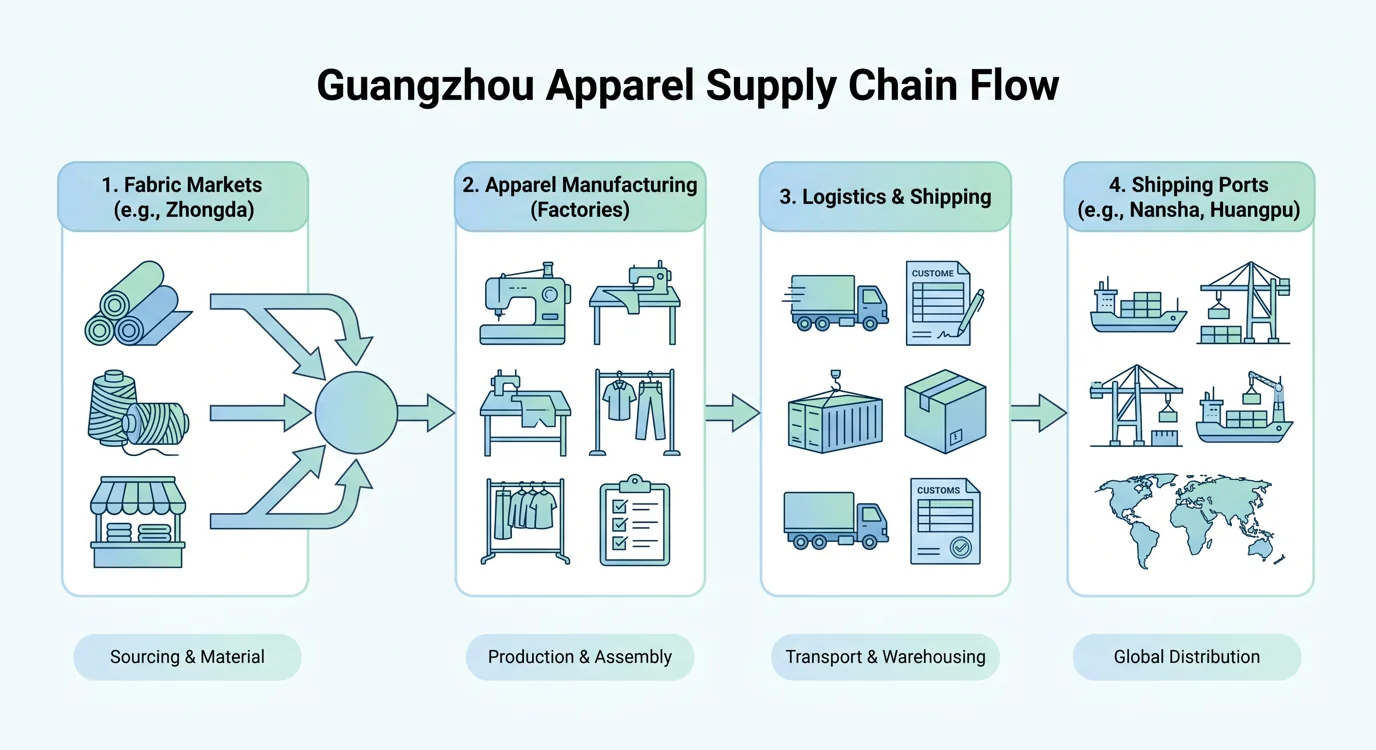
Your clothing brand’s success depends not just on finding a good factory, but on understanding the entire ecosystem that transforms raw materials into finished products in your warehouse. Guangzhou’s apparel supply chain represents one of the world’s most sophisticated textile and garment manufacturing networks—yet many buyers interact with only a single node in this complex system.
The difference between buyers who struggle with delays, quality issues, and cost surprises and those who operate smoothly often comes down to supply chain literacy. Understanding how materials flow from fiber producers to your retail shelf enables better decisions at every stage.
This guide illuminates the complete Guangzhou apparel supply chain, from fabric markets through manufacturing to shipping logistics.
Czego się nauczysz:
- How Guangzhou’s textile ecosystem operates
- Where to source fabrics, trims, and components
- How to coordinate multi-stage production
- Logistics options and cost considerations
- Building resilient supply chain relationships
Spis treści
- Understanding Guangzhou’s Textile Ecosystem
- Fabric Sourcing Channels
- Trim and Component Supply
- Production Coordination
- Quality Management Integration
- Logistics and Shipping
- Building Supply Chain Resilience
- FAQ: Supply Chain Management
Understanding Guangzhou’s Textile Ecosystem
Guangzhou and the surrounding Pearl River Delta region constitute the world’s most concentrated textile and apparel manufacturing cluster. Understanding this ecosystem helps you navigate it effectively.
The textile value chain in Guangzhou:
The region hosts every stage of textile and apparel production:
- Fiber production and processing: Cotton spinning, synthetic filament extrusion
- Fabric manufacturing: Weaving, knitting, dyeing, finishing
- Component production: Buttons, zippers, labels, interlining
- Garment manufacturing: Cutting, sewing, finishing
- Logistics and export: Freight forwarding, customs, shipping
This concentration enables remarkable efficiency. Within a two-hour drive, you can access fabric markets, component suppliers, and garment factories covering every requirement.
Key industrial zones and their specializations:
Different areas of Guangzhou and surrounding cities specialize in different products:
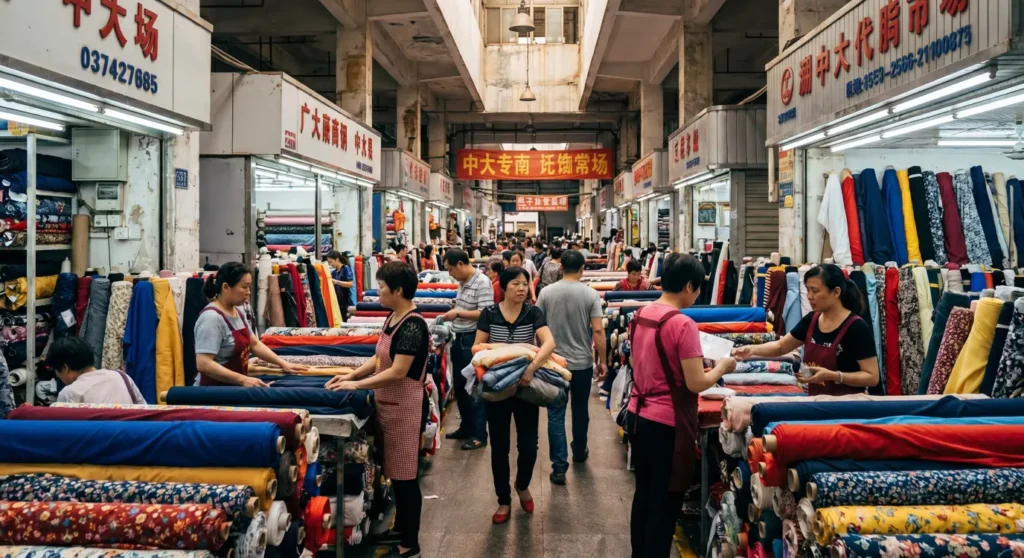
- Zhongda Textile Market (Haizhu District): Fabric trading hub, particularly for cotton and blended fabrics
- Shaoxing Keqiao (2 hours north): China’s largest textile market, comprehensive range
- Panyu District: Large-scale garment manufacturing, denim specialists
- Nansha District: Port access, large factory facilities
- Shenzhen (1 hour south): Technical fabrics, high-end production, embroidery specialists
Sourcing strategically based on these specializations improves access and often pricing.
Fabric Sourcing Channels
Fabric typically represents 40-60% of garment cost. Understanding fabric sourcing options affects both cost and quality.
Wholesale textile markets:
Guangzhou’s fabric markets offer immediate access to thousands of fabric varieties:
Zhongda Textile Market serves as Guangzhou’s primary fabric trading center. Multiple buildings house hundreds of vendors selling:
- Cotton, linen, silk, and synthetic fabrics
- Printed and dyed materials
- Technical and performance fabrics
- Specialty weaves and finishes
Shaoxing Keqiao Textile City (2 hours by high-speed rail) offers even greater variety. Many buyers make regular sourcing trips to Shaoxing for fabric that isn’t readily available in Guangzhou.
Factory-direct fabric sourcing:
For larger orders or specific requirements, direct fabric factories offer advantages:
- Consistent quality across larger quantities
- Custom colors and specifications
- Better pricing for high-volume needs
- Direct technical communication
Factory-direct sourcing typically requires minimum orders of 1,000+ meters and longer lead times.
Commission dyeing and finishing:
When market fabrics don’t meet specifications, commission processing offers solutions:
- Dyeing: Achieve specific colors on greige fabric
- Finishing: Add treatments (softening, water resistance, etc.)
- Printing: Custom patterns on greige fabric
Commission processing adds 2-3 weeks to lead time but enables precise specification matching.
Trim and Component Supply
Trims—buttons, zippers, labels, interlining—require coordinated sourcing decisions.
Sourcing trim components:
Guangzhou offers trim suppliers for every requirement:
- Buttons: Specialty button markets and custom manufacturers
- Zippers: YKK authorized distributors and local manufacturers
- Etykiety: Screen printers and woven label factories
- Interlining: Fusible and sewn-in varieties from multiple suppliers
Factory partnerships often include trim sourcing—factories have established supplier relationships that provide convenience and sometimes cost advantages.
Custom versus standard components:
Standard components (off-the-shelf zippers, generic buttons) offer:
- Immediate availability
- Lower cost for small quantities
- Proven reliability
Custom components (branded labels, specialized hardware) provide:
- Brand consistency
- Unique product differentiation
- Complete design control
Balance custom component investment against order quantities—custom components rarely make sense for very small runs.
Labeling and packaging compliance:
Different markets have varying labeling requirements:
- Country of origin labels
- Fiber content labels
- Care instruction symbols
- Brand labels and size labels
Factor compliance requirements into packaging specifications. Your factory should understand requirements for your target markets, but verification remains your responsibility.
Production Coordination
Coordinating multi-stage production requires attention to timing, quality, and communication.
Typical production flow:
Standard garment production follows this sequence:
- Material sourcing: Fabric and trim procurement (5-15 days)
- Material verification: Quality checking upon receipt (1-3 days)
- Tworzenie wzorów: Creating cutting patterns (2-5 days)
- Cięcie: Fabric cutting for all sizes (1-3 days)
- Szycie: Assembly of garments (7-20 days depending on complexity)
- Wykończenie: Final processing, pressing, inspection (2-5 days)
- Pakowanie: Individual and carton packaging (1-3 days)
- Quality inspection: Final quality verification (1-2 days)
Total timeline: 3-6 weeks for standard orders from production start to shipment readiness.
Coordinating multiple stages:
When different suppliers handle different stages, coordination complexity increases:
- Schedule material delivery to match production readiness
- Build buffer time for unexpected delays
- Maintain communication across all parties
- Verify quality at each stage, not just final inspection
Factory selection often depends on their coordination capabilities as much as their production capabilities.
Production scheduling considerations:
Account for:
- Factory current workload (peak seasons create bottlenecks)
- Material availability (specialty fabrics may require longer procurement)
- Quality issues requiring rework
- Logistics scheduling for shipping
Realistic scheduling prevents rushed production that compromises quality.
Quality Management Integration
Quality management across the supply chain requires systems, not just inspection.
Material quality control:
Verify materials before they enter production:
- Fabric testing for color, weight, composition, and quality
- Trim inspection for functionality and appearance
- Packaging material verification
Material issues discovered during production cause delays and waste. Catching problems at receipt prevents propagation.
In-process quality monitoring:
During production, establish checkpoints:
- Cutting quality verification
- First article inspection
- Periodic sampling during sewing
- Half-production comprehensive review
Quality issues detected early enable correction. Issues detected only at final inspection may require expensive rework or acceptance of defective goods.
Factory quality systems:
Assess factory quality infrastructure:
- Dedicated QC staff and supervision
- Measurement and testing equipment
- Documented quality procedures
- Problem identification and resolution processes
Factories with established quality systems deliver more consistent results than those relying solely on inspection.
Logistics and Shipping
Getting finished goods from Guangzhou to your warehouse requires logistics planning.
Opcje wysyłki:
| Metoda | Koszt | Transit Time | Najlepsze dla |
|---|---|---|---|
| Sea freight (FCL) | $1,500-3,500/container | 25-35 dni | Large orders (500+ units) |
| Fracht morski (LCL) | $80-180/CBM | 25-35 dni | Medium orders (50-500 units) |
| Fracht lotniczy | $3-6/kg | 5-10 dni | Urgent/replenishment orders |
| Express | $8-15/kg | 3-5 dni | Samples/small urgent orders |
For typical clothing orders, sea freight offers best value. LCL (less than container load) provides access to sea freight economics for smaller volumes.
Port selection:
Major export ports serving Guangzhou region:
- Nansha Port: Closest to Guangzhou manufacturing areas
- Shenzhen (Yantian): Established routes, frequent sailings
- Hong Kong: Extensive global connectivity
Factory logistics teams typically handle port selection based on destination and service.
Documentation requirements:
Export documentation includes:
- Faktura handlowa
- Lista pakowania
- Bill of lading (or air waybill)
- Certificate of origin
- Quality inspection reports (if applicable)
Factory or freight forwarder preparation is standard, but verification remains your responsibility.
Duties and import taxes:
Import duties on apparel vary by destination country:
- United States: 12-20% depending on category
- European Union: 12% + VAT
- United Kingdom: 12% + VAT
- Australia: 5-10%
Calculate total landed cost including duties, not just unit price and shipping.
Building Supply Chain Resilience
Disruptions happen. Building resilient supply chains prevents single-point failures.
Supplier redundancy:
Avoid single-source dependencies:
- Identify backup suppliers for critical materials
- Qualify secondary factories for core products
- Diversify logistics providers
When disruptions occur—factory fires, port congestion, material shortages—redundancy enables continuity.
Buffer inventory strategies:
Strategic inventory buffers provide cushion:
- Maintain 2-4 weeks of finished goods inventory
- Safety stock for popular styles
- Critical material buffer for long-lead items
Inventory costs money but prevents stockouts and provides negotiating leverage.
Relationship depth:
Strong supplier relationships matter in crises:
- Factories prioritize reliable, long-term clients during shortages
- Logistics providers offer better service to established accounts
- Material suppliers extend terms when relationships warrant
Invest in relationship building, not just transactional procurement.
Jak Algo Bert Fashion może pomóc
At Algo Bert Fashion, we provide comprehensive supply chain coordination services. We navigate Guangzhou’s textile ecosystem daily, connecting clients with appropriate suppliers across the complete value chain.
Our supply chain services include:
- Fabric and trim sourcing coordination
- Production scheduling and monitoring
- Quality management integration
- Logistics arrangement and documentation
- Full supply chain visibility and reporting
Learn more about our supply chain services lub contact our team for consultation.
FAQ: Supply Chain Management
How do I source fabrics in Guangzhou?
Fabric sourcing options include wholesale markets (Zhongda for Guangzhou, Shaoxing Keqiao for comprehensive range), factory-direct for larger orders, and commission dyeing for custom colors. Visit markets personally for small quantities; work through factories or agents for larger commitments.
What is typical lead time for Guangzhou apparel production?
Standard lead time from production start to shipment readiness is 3-6 weeks. This includes material sourcing (1-2 weeks), cutting and sewing (2-3 weeks), and finishing/packing (1 week). Complex designs, specialty materials, or peak seasons extend timelines.
How can I reduce supply chain risk?
Reduce risk through supplier redundancy (qualify multiple factories), buffer inventory for critical products, strong supplier relationships, diversified logistics providers, and supply chain visibility enabling early problem identification.
What are the main logistics options from Guangzhou?
Sea freight (FCL container or LCL consolidation) offers best cost for larger orders. Air freight and express services provide faster delivery at higher cost. Port selection (Nansha, Shenzhen, Hong Kong) depends on destination and service availability.
How do I ensure quality across multiple suppliers?
Ensure quality through material verification at receipt, during-production checkpoints, clear specification documentation, and factory quality system assessment. Quality management integrated throughout production prevents problems better than final inspection alone.
Wnioski
The Guangzhou apparel supply chain offers extraordinary capability—one of the world’s most concentrated and efficient textile manufacturing ecosystems. Leveraging this ecosystem effectively requires understanding its structure, navigating its channels, and coordinating its various stages.
Build supply chain literacy to make better decisions. Establish systems for quality management across stages. Plan logistics early in production planning. Invest in supplier relationships that provide resilience when disruptions occur.
Ten artykuł jest częścią naszego kompleksowego przewodnika na temat znalezienie wiarygodnych producentów odzieży w Guangzhou.
Contact our team to optimize your supply chain lub request supply chain services
Powiązane posty:



 English (UK)
 Español
 Français
 Deutsch
 Português
 Italiano
 Polski
 Nederlands
 Svenska
 Русский
 Türkçe
 한국어
한국어