

The bawełna vs poliester decision shapes your entire clothing brand — from how your garments feel on skin to how much profit you keep per unit. Pick wrong, and you’ll face returns from uncomfortable customers, margins eaten by material costs, or sustainability claims that don’t hold up to scrutiny.
Yet most first-time founders choose fabric based on gut feeling rather than data.
This guide changes that. We break down the bawełna vs poliester comparison across every factor that actually matters for clothing brands in 2025: fiber performance, comfort, durability, manufacturing cost, environmental impact, and ideal product applications. Whether you’re launching organic cotton essentials or technical performance activewear, you’ll leave with a clear, data-backed answer for your specific product line.
What you’ll learn:
- The 7 critical differences between cotton and polyester that affect your brand
- Objective comfort and durability data — not marketing claims
- Real cost analysis showing how each fabric impacts your margins
- Environmental trade-offs that honest sustainability messaging requires
- Exactly which fabric fits which product category
- How blended fabrics can give you the best of both worlds
Spis treści
- Cotton vs Polyester: Understanding the Fibers
- Difference 1: Comfort and Wearability
- Difference 2: Durability and Longevity
- Difference 3: Cost and Profit Margin Impact
- Difference 4: Environmental Impact and Sustainability
- Difference 5–7: Printing, Care, and Best Applications
- Common Fabric Selection Mistakes to Avoid
- FAQ: Cotton vs Polyester Questions
Cotton vs Polyester: Understanding the Fibers
Before comparing performance, you need to understand what makes these two fibers fundamentally different. The cotton polyester difference starts at the molecular level — and those structural differences explain every comfort, durability, and cost trade-off that follows.
What Is Cotton?
Cotton is a natural cellulose fiber harvested from the bolls of the cotton plant (Gossypium), grown primarily in China, India, the United States, and Pakistan. The twisted, flat plant hairs are spun into yarn and woven or knitted into fabric. According to the International Cotton Advisory Committee, global cotton production exceeds 25 million metric tons annually — making it the world’s most important natural textile fiber.
Cotton’s cellular structure allows natural moisture absorption: the fiber can hold up to 7% of its weight in water before feeling damp. This absorption creates the breathability and cooling effect consumers associate with comfortable everyday clothing. Chinese cotton mills have refined processing over decades, producing everything from budget conventional cotton to certified organic varieties meeting GOTS (Global Organic Textile Standard) requirements.
What Is Polyester?
Polyester is a synthetic polymer — specifically polyethylene terephthalate (PET) — created through chemical processing of petroleum derivatives. The same base material used for plastic bottles is extruded into fibers with precisely engineered properties. This synthetic origin gives polyester predictable, consistent performance that varies minimally between production batches.
Modern polyester has evolved far beyond the stiff, shiny synthetics of decades past. Micro-denier polyester fibers (less than 1 denier diameter) create hand-feels approaching silk. Technical treatments add moisture-wicking, UV protection, and antimicrobial properties that expand polyester’s applications into performance categories cotton cannot serve.
Core Fiber Properties: Cotton vs Polyester at a Glance
| Property | Cotton | Polyester |
|---|---|---|
| Origin | Natural plant fiber | Synthetic petroleum polymer |
| Breathability | Excellent | Moderate |
| Moisture absorption | High (7% of fiber weight) | Very low (0.4% of fiber weight) |
| Drying speed | Slow | Fast |
| Wrinkle resistance | Low | Wysoki |
| Shrinkage risk | High (3–5% first wash) | Low (1–2%) |
| UV resistance | Moderate | Good |
| Static cling | Low | Wysoki |
| Pilling tendency | Low–moderate | Moderate–high (varies by quality) |
| Biodegradable | Yes (months) | No (200+ years) |
These numbers aren’t marketing — they’re textile science. And they drive every bawełna vs poliester trade-off your brand will face.
Difference 1: Comfort and Wearability
Comfort is the reason customers keep or return your garments. The bawełna vs poliester comfort gap depends entirely on the product category and wearing context.
Cotton’s Comfort Advantages
Cotton remains the benchmark for next-to-skin comfort in casual and everyday apparel. The natural fibers deliver soft hand-feel, breathability, and hypoallergenic properties that synthetic alternatives still struggle to fully replicate.
Cotton’s moisture absorption creates a cooling effect in warm conditions — the fiber pulls sweat away from skin and releases it into the surrounding air through evaporation. This makes cotton ideal for:
- Everyday t-shirts and casual shirts
- Underwear and intimates
- Baby and children’s clothing (hypoallergenic)
- Loungewear and sleepwear
- Summer-weight garments
For brands targeting comfort-first positioning — think premium basics, organic essentials, or sensitive-skin collections — cotton’s natural feel justifies higher price points and builds the tactile brand experience customers remember.
Polyester’s Performance Comfort
Where cotton absorbs moisture, polyester repels it — pushing sweat to the fabric surface where it evaporates quickly. This wicking action keeps athletes drier during high-intensity activity, which is why polyester dominates sportswear, athletic base layers, and outdoor performance apparel.
Additional polyester comfort advantages:
- Wrinkle resistance — polyester emerges from suitcases looking pressed, making it superior for travel clothing and professional wear.
- Shape retention — polyester holds its structure through hundreds of wash cycles, preventing the stretching and sagging that affects cotton garments over time.
- Lightweight options — micro-denier polyester creates ultralight fabrics that reduce garment weight without sacrificing coverage.
Blended Fabrics: The Practical Middle Ground
The cotton or polyester debate often resolves itself with blends. A 60/40 cotton-polyester blend captures cotton’s softness and breathability while incorporating polyester’s wrinkle resistance and dimensional stability. These blends:
- Cost less than pure cotton
- Outperform pure polyester in skin comfort
- Reduce shrinkage versus 100% cotton
- Enable competitive pricing at solid margins
Most mass-market t-shirt brands use blends for exactly this reason — the cotton polyester combination delivers the best value-to-comfort ratio for everyday wear.
Difference 2: Durability and Longevity
Durability impacts return rates, customer satisfaction, and your brand’s reputation for quality. The bawełna vs poliester durability gap is significant — and it favors polyester in almost every measurable metric.
Cotton Durability: Good, Not Great
Cotton offers moderate durability suitable for everyday casual wear:
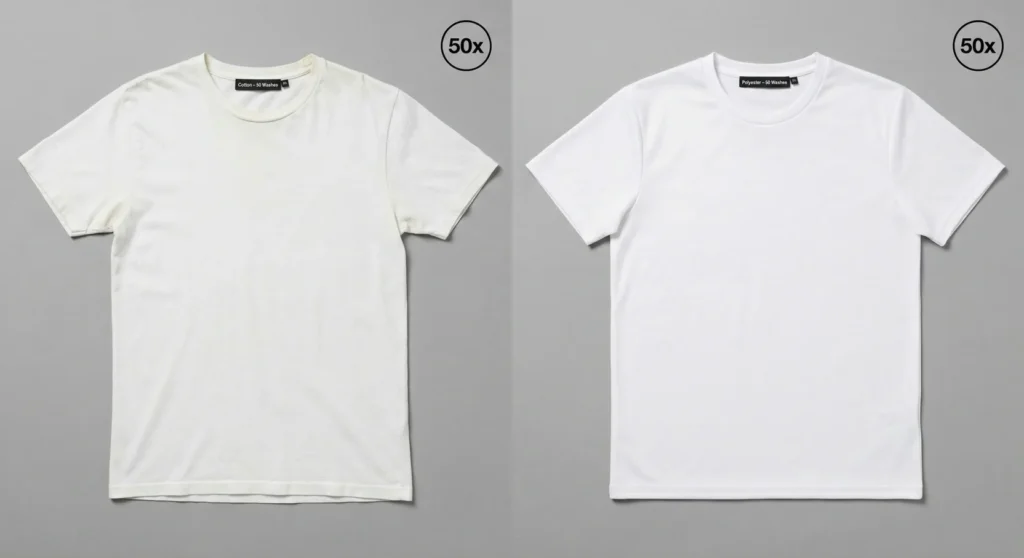
- Tensile strength drops 30–40% when wet — meaning cotton garments weaken during every wash cycle.
- Shrinkage of 3–5% on first wash, with additional shrinkage possible from heat exposure over time.
- Visible wear patterns develop in high-friction zones (underarms, collar edges, inseams) after 30–50 washes.
- UV degradation weakens fibers over time in sun-exposed garments.
Quality cotton garments last several years with proper care, developing a soft, lived-in character many consumers love. But they won’t survive the abuse that polyester handles easily.
Production note: Chinese garment factories typically pre-shrink cotton fabrics through sanforization or compressive shrinkage finishing. This reduces — but doesn’t eliminate — consumer shrinkage. Always test actual shrinkage on production fabric before finalizing patterns.
Polyester Durability: Built to Last
Polyester outperforms cotton on virtually every durability measure:
- Maintains strength wet or dry — no degradation from washing.
- Minimal shrinkage (1–2%) even with aggressive laundering.
- Superior abrasion resistance — resists thinning in high-friction areas.
- Mildew and mold resistant — won’t degrade in humid storage conditions.
- Colorfastness — retains dye color through hundreds of washes.
According to textile testing data from AATCC (American Association of Textile Chemists and Colorists), polyester fabrics consistently outperform cotton in accelerated aging tests simulating years of wear and washing.
For children’s clothing, workwear, uniforms, and athletic apparel — any category where garments face heavy use and frequent laundering — polyester’s durability advantage translates directly to longer product life and lower cost-per-wear.
Difference 3: Cost and Profit Margin Impact
Material cost is one of the largest line items in your manufacturing budget. The bawełna vs poliester price difference directly shapes your margins, retail pricing, and competitive positioning.
Cotton Pricing: Higher and Volatile
Cotton prices fluctuate with global commodity markets, weather events, and harvest yields. A poor growing season in India or China can spike prices overnight:
| Cotton Type | Cost per Yard | Impact per T-Shirt |
|---|---|---|
| Conventional cotton jersey | 4.00 | 5.00 |
| Ringspun combed cotton | 6.00 | 7.00 |
| Organic certified cotton | 10.00 | 12.00 |
| Premium Pima/Supima cotton | 15.00+ | 18.00+ |
This volatility makes cotton budgeting challenging for brands that need predictable costs for wholesale pricing and financial planning. Locking in fabric pricing through advance purchase agreements with mills can reduce exposure — but requires capital commitment.
Polyester Pricing: Lower and Stable
Polyester benefits from massive manufacturing scale and less price volatility:
| Polyester Type | Cost per Yard | Impact per T-Shirt |
|---|---|---|
| Basic polyester jersey | 3.00 | 3.50 |
| Performance moisture-wicking | 6.00 | 7.00 |
| Recycled polyester (rPET) | 7.00 | 8.00 |
| Premium technical polyester | 12.00 | 14.00 |
Polyester’s lower base cost and reduced shrinkage also improve manufacturing efficiency. Cotton requires pre-washing and stabilization before cutting — polyester can be cut immediately upon arrival, reducing production lead time and work-in-progress costs.
Margin Impact Example
For a basic crewneck t-shirt retailing at $30:
| Fabric Choice | Material Cost | FOB Unit Cost | Gross Margin |
|---|---|---|---|
| 100% cotton | $4.50 | $9.80 | 67.3% |
| 60/40 cotton-poly blend | $3.20 | $8.20 | 72.7% |
| 100% polyester | $2.80 | $7.50 | 75.0% |
| Organic cotton | $8.00 | $13.50 | 55.0% |
The cotton polyester difference in margin is 7.7 percentage points on a single basic tee. At 5,000 units, that’s $11,500 in additional gross profit from choosing polyester over cotton — or additional cost you accept for cotton’s comfort and positioning benefits.
Difference 4: Environmental Impact and Sustainability
Sustainability increasingly drives purchasing decisions, especially among millennial and Gen Z consumers. The bawełna vs poliester environmental comparison is more nuanced than most brands acknowledge — and honest messaging matters.
Cotton’s Environmental Profile
The good:
- Biodegradable — decomposes within months in composting conditions
- Renewable agricultural resource
- No microplastic pollution during washing
- Organic cotton eliminates synthetic pesticide and fertilizer use
The challenging:
- Massive water consumption — approximately 2,700 liters per single t-shirt according to WWF data
- Conventional cotton uses ~16% of global insecticides on only 2.4% of farmland
- Land use competition with food crops
- Chemical-intensive processing (bleaching, dyeing, finishing)
Polyester’s Environmental Profile
The good:
- Requires minimal water during production (compared to cotton farming)
- Longer garment lifespan reduces replacement frequency
- Recycled polyester (rPET) diverts plastic bottles from landfills
- rPET production uses 30–50% less energy than virgin polyester
The challenging:
- Derived from petroleum — a non-renewable fossil fuel
- Microplastic shedding — every wash releases thousands of microscopic plastic fibers into waterways. Research published in Environmental Science & Technology estimates synthetic textiles contribute 500,000–1,000,000 tons of microfibers to oceans annually.
- Not biodegradable — takes 200+ years to decompose
- Energy-intensive manufacturing process with greenhouse gas emissions
The Honest Sustainability Position
Neither fiber is environmentally innocent. Brands claiming “cotton is sustainable” ignore water and pesticide impacts. Brands claiming “recycled polyester saves the planet” ignore microplastic pollution.
The most credible approach: acknowledge trade-offs transparently and select the most responsible option for each specific product.
| Sustainability Goal | Better Choice |
|---|---|
| Reduce microplastic pollution | Cotton or organic cotton |
| Minimize water consumption | Polyester or recycled polyester |
| Biodegradable end-of-life | Cotton |
| Reduce virgin resource extraction | Recycled polyester (rPET) |
| Longest garment lifespan | Polyester |
| Zero synthetic chemical exposure | GOTS-certified organic cotton |

Differences 5–7: Printing, Care, and Best Applications
Difference 5: Printability
Cotton wins for printing. The natural fiber surface absorbs ink readily, producing vibrant, durable prints through both screen printing and direct-to-garment (DTG) methods. Polyester requires specialized inks (sublimation or modified DTG) and pretreatments that add cost and complexity. For print-heavy brands — graphic tees, custom merchandise, branded apparel — cotton’s superior printability often outweighs polyester’s other advantages.
Difference 6: Care Requirements
Polyester wins for easy care. It can be machine washed and dried repeatedly with minimal impact on appearance or fit. Cotton requires more careful laundering — cold water, gentle cycles, limited tumble drying — to prevent shrinkage and premature wear. This care difference affects customer satisfaction: low-maintenance polyester garments receive fewer complaints about post-wash appearance changes.
Difference 7: Best Product Applications
Choose cotton for:
- Premium basics and essentials
- Underwear, loungewear, sleepwear
- Baby and children’s clothing (sensitivity)
- Print-focused graphic tees
- Sustainable/organic brand positioning
- Summer and warm-climate collections
Choose polyester for:
- Activewear and performance sportswear
- Outdoor and technical outerwear
- Uniforms and workwear
- Travel and wrinkle-free clothing
- Sublimation-printed all-over designs
- Budget basics at high volume
Choose cotton-polyester blends for:
- Everyday casual t-shirts (60/40 or 50/50)
- Mid-range basics balancing comfort and cost
- Fleece and flannel products
- Products needing cotton comfort with polyester durability

Common Fabric Selection Mistakes to Avoid
Mistake 1: “Natural = Always Better”
Many founders assume cotton’s natural origin automatically makes it superior. This ignores polyester’s legitimate performance advantages and cotton’s real environmental costs. Evaluate fabric based on product requirements, not fiber origin ideology.
Mistake 2: Ignoring Shrinkage in Cotton Patterns
Failing to add 5–8% shrinkage allowance to cotton patterns produces garments that become too small after first wash. Always test actual fabric shrinkage before finalizing production patterns. Include clear care labels recommending cold wash and air dry.
Mistake 3: Choosing Fabric Without Wear Testing
Ordering bulk fabric based solely on swatch samples — without producing and testing actual garments through multiple wash cycles — leads to expensive surprises. Always produce sample garments, wear-test them, and wash-test them before committing to production fabric orders.
Mistake 4: Overlooking Polyester Static Issues
Polyester’s static cling causes discomfort in dry climates and low-humidity seasons. Choose anti-static finished polyester for winter collections, or opt for cotton-rich blends that eliminate static while maintaining polyester’s other advantages.
Mistake 5: Ignoring Blends Entirely
The cotton or polyester question often has a third answer: blended fabrics. Many brands lock into one fiber when a blend would deliver better customer satisfaction at lower cost. Test blended options before committing exclusively to either pure fiber.
How Algo Bert Fashion Helps You Choose the Right Fabric
The bawełna vs poliester decision is just the starting point. At Algo Bert Fashion, we help clothing brands navigate fabric selection, sourcing, and production with hands-on expertise from Guangzhou — China’s largest textile hub.
Our team sources and evaluates fabrics across every category: conventional cotton, organic cotton, performance polyester, recycled polyester, and custom blends. We provide physical swatch samples, conduct wash testing, and coordinate sample garment production so you can make fabric decisions based on real product performance — not supplier claims.
Our Fabric Services:
- Fabric sourcing and selection — verified suppliers across cotton, polyester, and specialty materials
- Swatch sampling — physical fabric samples shipped to you before any commitment
- Wash and wear testing — we test fabric performance through multiple wash cycles before production
- Sustainability consultation — guidance on organic cotton, recycled polyester, GOTS, and GRS certification options
- Cost optimization — leveraging volume relationships to negotiate competitive fabric pricing
- Sample garment production — test your chosen fabric in actual garment form before bulk manufacturing
Explore our fabric sourcing services
FAQ: Cotton vs Polyester Questions
What is the main difference between cotton and polyester?
The core cotton polyester difference is fiber origin: cotton is a natural plant fiber, polyester is a synthetic petroleum-based polymer. This creates divergent properties — cotton offers breathability and softness, polyester delivers durability and moisture-wicking performance. Neither is universally better; the right choice depends on your product requirements and customer expectations.
Is cotton more comfortable than polyester?
For casual everyday wear and next-to-skin applications, cotton is generally more comfortable due to its softness, breathability, and hypoallergenic properties. However, for athletic and performance contexts, polyester’s moisture-wicking capability keeps the wearer drier and more comfortable during intense activity. Many brands find that cotton polyester blends offer the best comfort balance for general-purpose garments.
Which fabric is more durable: cotton or polyester?
Polyester is significantly more durable. It maintains strength when wet, resists abrasion, shrinks minimally, and retains color through hundreds of washes. Cotton loses 30–40% of its tensile strength when wet and shows visible wear after 30–50 wash cycles. For high-use, high-wash products, polyester’s durability advantage is substantial.
Which is more sustainable: cotton or polyester?
Neither fiber offers clear sustainability superiority across all metrics. Cotton is biodegradable and avoids microplastic pollution but requires enormous water and pesticide inputs. Polyester produces microplastic pollution and derives from fossil fuels but uses less water and lasts longer. Organic cotton and recycled polyester improve each fiber’s environmental profile. The most honest approach is transparent trade-off acknowledgment.
Does cotton shrink more than polyester?
Yes. Cotton typically shrinks 3–5% on first wash with additional shrinkage possible from heat exposure. Polyester shrinks 1–2% or less. This difference requires cotton brands to build shrinkage allowance into pattern sizing and provide clear care instructions to customers.
Can you mix cotton and polyester?
Absolutely. Cotton polyester blends are among the most popular fabrics in apparel manufacturing. Common ratios include 60/40, 50/50, and 65/35 (cotton/polyester). Blends combine cotton’s comfort with polyester’s wrinkle resistance, durability, and lower cost — often delivering the best practical value for everyday clothing.
Which fabric is better for t-shirt printing?
Cotton produces superior results for screen printing and DTG printing because the natural fiber absorbs ink readily, creating vibrant and durable prints. Polyester requires specialized sublimation inks or modified DTG processes that add cost. For graphic tees and print-heavy brands, cotton or cotton-dominant blends are the stronger fabric choice.
How do I choose between cotton and polyester for my brand?
Start with your product category and customer expectations. Premium casual basics, organic positioning, and print-focused products favor cotton. Performance sportswear, uniforms, travel clothing, and budget basics favor polyester. Test both options as sample garments before committing — your customers’ real-world experience matters more than any comparison chart.
Conclusion
The bawełna vs poliester decision isn’t about finding a universal winner — it’s about matching fiber properties to your specific product, customer, and brand positioning.
Cotton delivers natural comfort, breathability, printability, and biodegradability that justify premium pricing for casual and organic collections. Polyester offers durability, performance, easy care, and cost efficiency that dominate activewear, workwear, and high-volume basics. Blended fabrics provide practical middle ground that works for the majority of everyday apparel.
The brands that make the smartest fabric decisions don’t choose based on assumption or ideology. They test both options in actual garment form, evaluate real-world performance through wash and wear cycles, and select the fiber — or blend — that delivers the best customer experience at sustainable margins.
That’s how great clothing brands are built. One fabric decision at a time.
Ready to source the right fabric for your product line? Let Algo Bert Fashion help you navigate the bawełna vs poliester decision with hands-on fabric expertise, physical samples, and production support from Guangzhou.
Get a Fabric Consultation → | Request a Production Quote →
Related Posts:

 English (UK)
 Español
 Français
 Deutsch
 Português
 Italiano
 Polski
 Русский
 한국어
한국어