

A founder of a UK womenswear brand walked into a Guangzhou factory in early 2025 with a problem. Her brand had grown from 2,000 units per season to 8,000 units over 18 months, but her sourcing operation had not kept up. She was personally managing five different factories across three product categories, chasing samples via WeChat at midnight, and missing delivery dates because she had no system for tracking production timelines across suppliers.
Her margin had dropped from 52% to 38% in one year. Not because of production costs — but because of the hidden expenses of uncoordinated sourcing.
That situation — brands outgrowing their sourcing capabilities — is surprisingly common. Professional clothing sourcing Guangzhou requires more than knowing which factories to call. It requires infrastructure, relationships, and processes that scale with your order volume. Whether you are a startup founder handling procurement yourself or an established brand looking to optimize, mastering professional clothing sourcing Guangzhou is the difference between growth that is profitable and growth that bleeds margin.
I have seen too many brands make the same mistake. They treat sourcing as something they will fix later. But by the time it breaks, the damage is already done.
Table of Contents
When to Professionalize Your Professional Clothing Sourcing Guangzhou Operation
The line between manageable sourcing and chaos is not always obvious. Most brands do not realize they have crossed it until a problem surfaces that their current approach cannot handle.
Signs Your Current Approach Isnt Scaling
Three patterns tell you your sourcing needs professional infrastructure. The first is quality inconsistency across repeat orders. When the same factory produces garments that pass inspection one month and fail the next, the issue is not the factory. It is the lack of documented specifications and quality standards that travel with each order.
Communication breakdown as factory count increases. A brand managing two factories can keep details in a spreadsheet. A brand managing six factories across woven, knit, and accessory categories needs a system. When sample approvals, tech pack revisions, and shipping instructions live in scattered WeChat threads, mistakes become inevitable.
Then there is margin erosion from uncoordinated logistics. A brand paying per-unit air freight on 15% of orders because production delays pushed them past sea freight deadlines is bleeding margin that a professional sourcing operation would prevent. The International Trade Centre found that companies with structured supplier management systems reduce logistics-related cost overruns by an average of 22%.
The Hidden Cost of DIY Sourcing at Scale
Managing sourcing without dedicated systems costs more than most brands realize. Consider this: a brand producing 50,000 units annually across eight factories, with the founder spending 15 hours per week on sourcing coordination. That brand is effectively paying for a full-time sourcing manager in lost founder time — time not spent on product development, marketing, or brand building.
The financial costs add up differently. Sample redevelopment because specifications were unclear — that costs $100 to $300 per round. Air freight premiums for missed sea freight windows — $2 to $5 per unit.
Defective goods that pass inspection because no standard protocol exists — those cost the full production value. Taken together, these costs amount to 8-15% of total procurement spend for brands without professional sourcing systems, based on interviews with sourcing managers across the industry.
Key Decision Points for Going Pro
When should you make the leap? Three triggers are consistent across brands I have worked with.
The first is managing more than three active factory relationships simultaneously. The second is annual production volume exceeding 20,000 units. The third is quality or delivery issues appearing in more than 10% of orders.
Hit any of these thresholds, and investing in professional sourcing infrastructure — whether internal hires, external agents, or hybrid support — typically delivers a return within 6 to 12 months. The gains come through reduced defects, better pricing, and fewer logistical emergencies.
Sourcing Agent vs Direct Factory Relationships
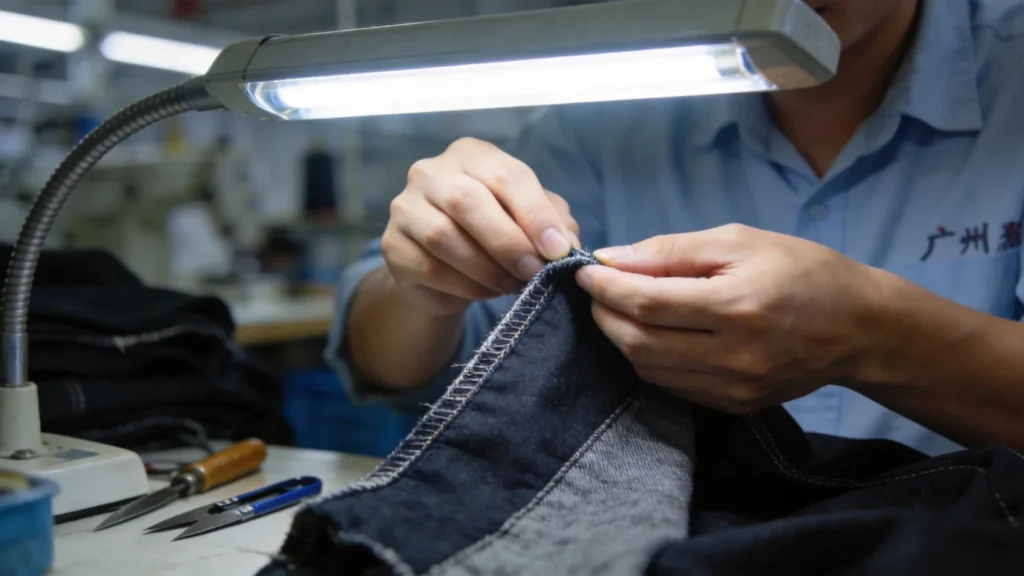
Every brand faces this question eventually. Should you work through sourcing agents or build direct factory relationships? The answer, for most brands at scale, is both.
When Agents Deliver Maximum Value
Sourcing agents charge 3-8% of order value, typically as a commission from the factory (though some charge the buyer directly). That fee covers factory identification, communication support, quality oversight, and problem resolution.
Is it worth it? Yes — but only in the right situations.
Agents deliver most value in three scenarios. First, during market entry — when a brand has no existing factory relationships in Guangzhou and needs to identify capable suppliers. Second, for complex orders involving new product types, where the agents expertise with specific factories reduces the sampling cycle. Third, for quality assurance — an agent conducting mid-production inspections across multiple factories provides oversight that would require a full-time QC hire to replicate.
One example: a London-based streetwear brand working with a Guangzhou sourcing agent. Their sample approval cycle dropped from 21 days to 11 days after engaging agent support for factory communication and specification translation. The agents 5% commission was offset entirely by the reduction in sample development costs alone.
Building and Managing Direct Partnerships
Direct relationships offer cost savings — no commission — and deeper partnership potential. But they require real investment.
Brands managing direct relationships need Chinese language capability, or reliable translation. Familiarity with factory culture and negotiation practices. And the time to visit factories at least once per year.
Here is the cost comparison you need to see. A brand producing $500,000 annually through an agent at 5% commission pays $25,000 in fees. Hiring a sourcing manager costs $40,000 to $60,000 annually including expenses.
The sweet spot? A hybrid approach — direct relationships for core products and agent support for new categories — often provides the best economics.
Hybrid Models That Work
The most common structure among brands producing 20,000 to 100,000 units annually combines both:
Direct relationships for 60-70% of production volume. Agent-supported sourcing for 20-30%. Agent-facilitated quality inspection across all factories.
This structure keeps core production costs low while maintaining flexibility for new product development. A womenswear brand using this model reported reducing their average landed cost by 9% over 18 months. How? By shifting core knitwear production to direct relationships while using agent support to develop a new denim category with low MOQ manufacturers.
Building a Professional Clothing Sourcing Infrastructure in Guangzhou
Professional clothing sourcing from Guangzhou requires more than relationships. It requires systems that standardize how specifications, quality, and communication flow between your brand and your factories. The brands that build these systems are the ones that scale.
Specification and Documentation Systems
Every order starts with a tech pack. Professional sourcing operations maintain standardized tech pack templates that include graded specifications, construction details, trim and labeling requirements, and packaging instructions. These templates reduce ambiguity and ensure that different factories receive consistent information.
Heres a benchmark worth chasing: a complete tech pack should enable a factory to produce a first sample without asking clarifying questions. Brands achieving this level of documentation report 40-60% fewer sample iterations compared to brands using informal spec sheets.
Beyond individual tech packs, professional operations maintain a spec library — a centralized repository of all garment specifications, updated with each production run. This library becomes an institutional asset that survives staff changes and supports consistent quality across seasons.
Quality Management Protocols
Professional sourcers do not wait for defects to appear. They implement staged quality management.
Pre-production: approve samples and confirm specifications before production starts. In-process: inspect during cutting, sewing, and finishing stages to catch issues early. Final: conduct AQL-based inspection before shipment release.
A brand producing denim in Guangzhou reduced their final inspection defect rate from 7.2% to 2.1% over 12 months after implementing staged quality checks. The investment in in-process inspection cost $1,200 per production run. It saved an estimated $8,000 per run in rework and rejected goods.
The American Society for Quality publishes AQL standards that serve as the industry benchmark for acceptable defect levels in garment production.
Communication Frameworks for Cross-Border Sourcing
Time zones, language differences, and cultural communication styles make structured communication essential. Without it, even the best factory relationships break down.
What works? A fixed weekly check-in cadence with each factory, regardless of whether issues exist. This builds the habit of transparency — factories that know you check regularly are less likely to let problems slide.
Written confirmation of all verbal agreements. In Chinese factory culture, a verbal price agreement may be interpreted as a starting point for negotiation, not a commitment. Written confirmation — via email or WeChat — creates a different level of obligation.
A single point of contact on each side. When multiple people from your team communicate with multiple people at the factory, information gets lost. Designating one person as the primary channel reduces misunderstandings significantly.
Supplier Evaluation and Selection Process
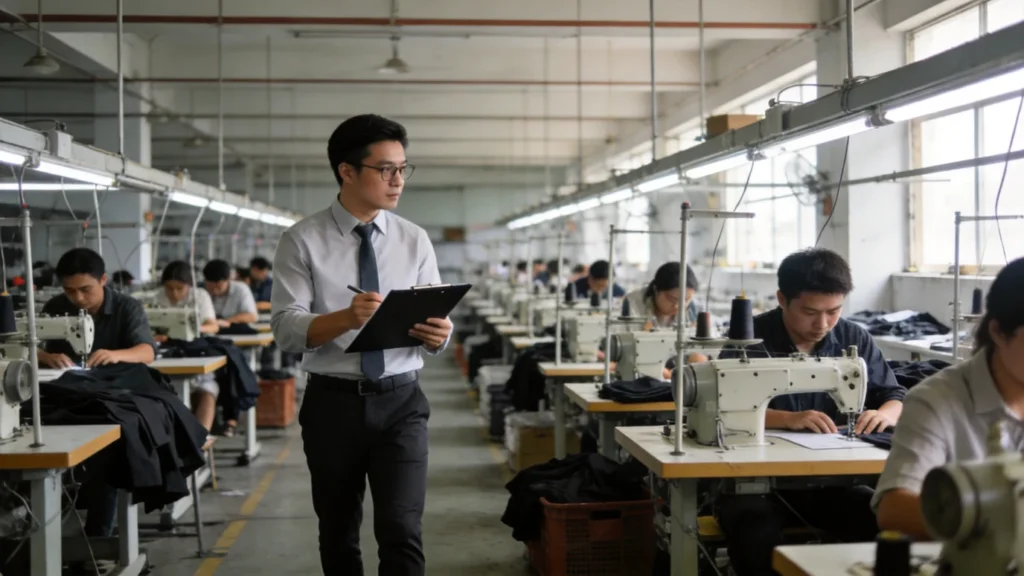
Selecting the right factory partners is the most consequential decision in professional clothing sourcing from Guangzhou. A structured evaluation process reduces the risk of choosing a supplier that cannot deliver at scale.
Qualification Criteria Beyond Price
Professional sourcers evaluate factories across multiple dimensions, not just unit price. Here is what the evaluation framework typically includes:
Production capacity: Does the factory have available capacity for your order volumes, including peak season flexibility?
Quality systems: Does the factory have documented quality procedures, trained QC staff, and a track record of consistent output?
Financial stability: Has the factory been operating for at least 3 to 5 years? Do they have stable relationships with fabric suppliers?
Communication capability: Does the factory have English-speaking staff who can handle technical discussions? How quickly do they respond to inquiries?
Compliance: Does the factory meet your compliance requirements for labor, environmental, and safety standards?
Each dimension gets a weight based on your priorities. A brand prioritizing quality over price might weight quality systems at 35%, capacity at 25%, compliance at 20%, communication at 10%, and financial stability at 10%.
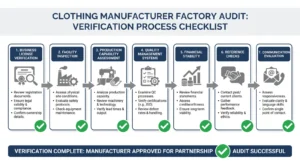
Factory Audit and Verification Protocols
A desktop evaluation identifies candidates. An on-site audit confirms them. Professional sourcers conduct structured audits that verify several things.
Actual production floor conditions against claims — the number of sewing stations, the condition of equipment, the flow of materials through the factory. Worker skill levels and training practices — a factory that invests in operator training typically produces more consistent quality than one that relies on temporary labor.
Management depth. Who runs production day-to-day? What happens when the owner is traveling? Factories with professional management layers are more reliable partners.
Red flags during audits: factories that resist showing production areas. Factories that claim capabilities they cannot demonstrate. Factories whose client list changes completely from season to season.
Negotiation and Contract Management
Professional sourcers negotiate more than price. Payment terms, lead times, MOQ commitments, and quality guarantees all belong in the commercial agreement.
Common terms for established relationships: 30% deposit with order, 70% net-30 after shipment. Brands with strong relationships negotiate net-60 terms on the balance, preserving cash flow while signaling trust.
Volume commitments deserve documentation. A brand committing to 5,000 units per quarter should have that commitment documented with clear terms for both sides — guaranteed pricing, priority production slots, and a process for adjusting volumes if market conditions change.
Managing the End-to-End Professional Clothing Sourcing Guangzhou Cycle
Professional clothing sourcing Guangzhou covers the full cycle from sample development to delivered goods. Every stage needs structured oversight.
From Sample Development to Production
The sample phase determines production success. Professional sourcers manage this phase with clear milestones:
First sample (fit and construction): 2 to 3 rounds maximum before approval. Pre-production sample (production specs): confirms factory understands all requirements. Photo sample (for marketing): captured before bulk production begins. Shipment sample (from production run): confirms bulk quality matches approved sample.
A US-based activewear brand reduced their sample development cycle from 8 weeks to 5 weeks by implementing milestone-based sample management with their Guangzhou factory partner. Each sample round had a 5-day review window. Any round exceeding the window triggered a management escalation.
Quality Control and Inspection Strategies
Professional operations use statistically valid inspection methods rather than random checks. AQL (Acceptable Quality Level) inspection follows published standards:
Critical defects: zero tolerance. Major defects: AQL 1.0-2.5 (depending on product type). Minor defects: AQL 4.0.
Inspection timing matters. In-process inspection at 30-40% of production allows issues to be caught and corrected before they affect the entire run. Final inspection at 80% completion ensures the factory has time to address any problems found.
The cost of inspection is modest compared to the cost of defects. A professional inspection service in Guangzhou charges $300 to $500 per man-day. Against an order value of $15,000, that represents 2-3%. Far less than the 15-25% replacement cost if defective goods ship.
Logistics and Shipping Coordination
Professional sourcing operations plan shipping at the order placement stage, not after production completes. The decision framework for air versus sea freight depends on a few factors.
Order size — sea freight is economical above 2 to 3 cubic meters. Time sensitivity — sea freight takes 25 to 35 days from Guangzhou to Europe or the US West Coast. Product value — higher-value products can absorb air freight costs more easily.
A professional sourcer typically books sea freight capacity 4 to 6 weeks before the shipment date and maintains a contingency budget for air freight on urgent orders. The rule of thumb: no more than 10% of annual orders should require air freight. Brands exceeding this threshold need to examine their production planning, not their shipping method.
Scaling Supplier Relationships for Growth

The factories that deliver your best production are the ones you have invested in over time. Professional sourcers manage factory relationships strategically, not transactionally.
Primary vs Secondary Supplier Strategy
The standard structure: allocate 60-70% of volume to a primary factory and 30-40% across one or two secondary factories.
The primary factory receives consistent orders, strategic planning discussions, and relationship investment — visits, shared forecasts, collaborative problem-solving. In return, they offer priority production scheduling, better pricing, and flexibility during peak seasons.
Secondary factories receive enough orders to maintain active relationships — 15-20% of volume each. This ensures they can scale up quickly if the primary factory encounters problems. A dormant secondary relationship provides no real backup.
Capacity Planning and Volume Commitments
Professional sourcers share rolling 12-month forecasts with their primary factories. This allows factories to plan capacity — hire operators, order materials, schedule production lines — reducing the risk of capacity shortages during peak seasons.
In exchange for forecast visibility, factories typically offer priority pricing 3-5% below standard rates and guaranteed production slots. A Guangzhou knitwear factory that receives quarterly forecasts from a UK brand reported that they allocate dedicated production capacity for that brand during peak months. Something they do not offer to transactional clients.
Continuous Improvement with Factory Partners
The strongest sourcing relationships include structured continuous improvement. Professional sourcers conduct quarterly business reviews with key factories.
What do they review? Quality metrics — defect rates, inspection pass rates, sample approval times. Delivery performance — on-time shipment percentage, lead time trends.
Cost trends — price changes, efficiency improvements, material cost movements. Relationship health — communication quality, issue resolution speed, innovation suggestions.
These reviews transform the relationship from transactional to strategic. A factory that sees your commitment to continuous improvement invests more in your account than a factory that only receives orders and payment.
Measuring Sourcing Performance
Track the right metrics and your sourcing operation improves. Track the wrong ones and you optimize for the wrong things.
Key KPIs for Procurement Operations
| Metric | Target | What It Measures |
|---|---|---|
| On-time delivery | 95%+ | Reliability of factory commitments |
| First-pass quality | 90%+ | Quality without rework |
| Sample approval cycle | 14 days max | Speed of development |
| Defect rate (final inspection) | Under 3% | Production quality |
| Lead time stability | Within 5% of quoted | Production planning accuracy |
| Cost variance | Within 3% of quoted | Budget reliability |
Total Cost Analysis Beyond Unit Price
Professional sourcers calculate total landed cost, not just FOB price. Here is what the full calculation includes:
Unit price plus sample development costs (amortized across order volume) plus inspection costs plus shipping and insurance plus duties and tariffs plus payment processing fees plus quality failure costs (defects, returns, customer service).
A brand comparing two suppliers in Guangzhou found something interesting. Supplier A had a 12% higher unit price but a 4% lower total landed cost.
The reason? Lower defect rates, shorter lead times, and more reliable shipping. The unit price comparison alone would have led to the wrong decision.
Building a Continuous Improvement Loop
The final element of professional sourcing is the improvement cycle. Track your KPIs, identify underperforming areas, implement changes, and measure results. The cycle repeats quarterly, with each iteration tightening performance.
A Guangzhou-based sourcing operation serving European brands reported impressive results from this approach. On-time delivery improved from 82% to 94%. Defect rates dropped from 5.8% to 1.9%. All over 18 months of structured performance management.
Related Products
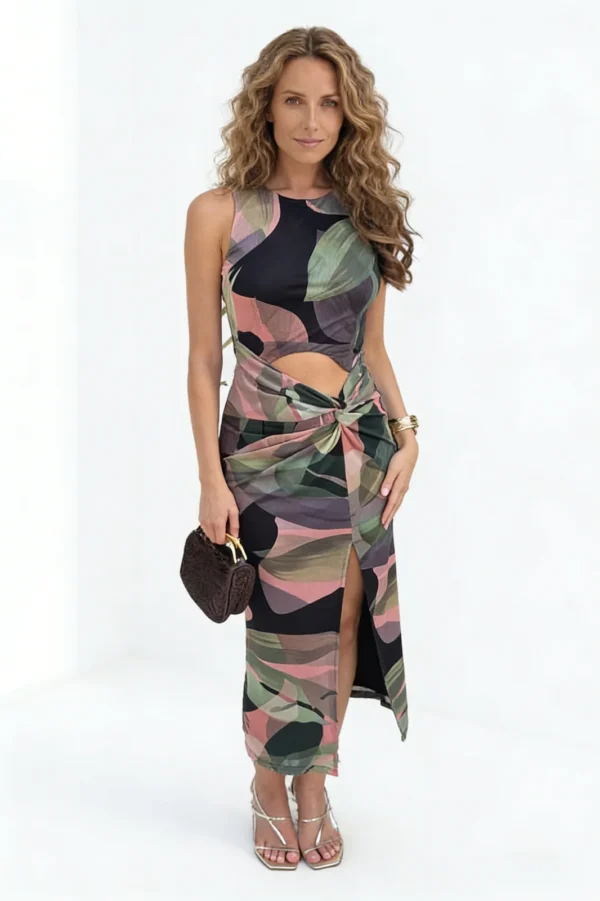
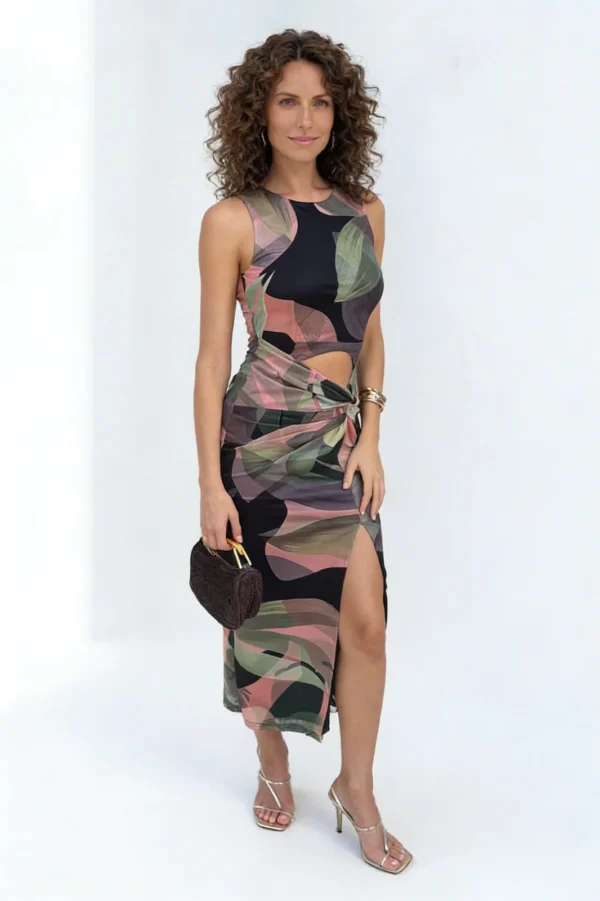
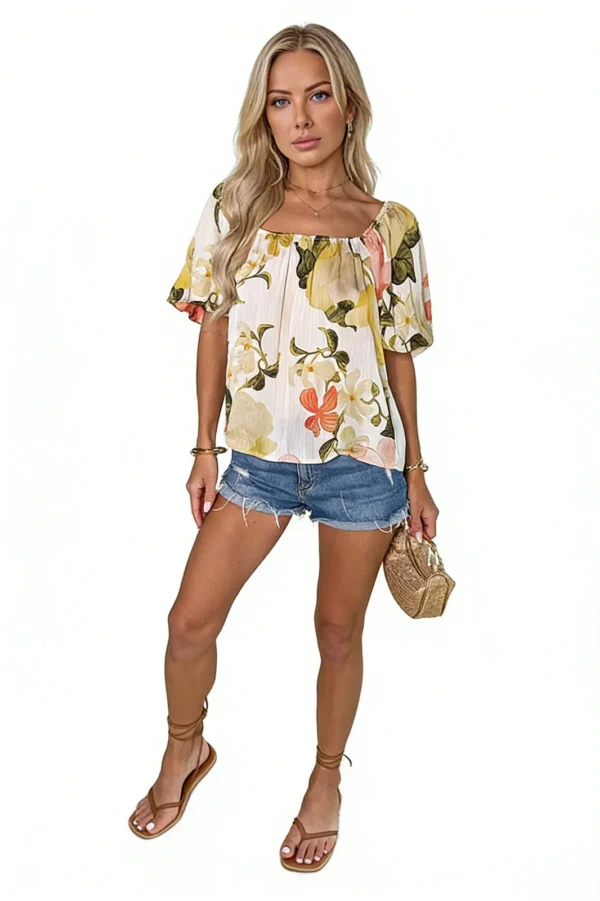
Looking for actual products produced by Guangzhou factories? These items showcase the quality and variety available through professional sourcing partners in the region:

Frequently Asked Questions
What is professional clothing sourcing Guangzhou?
Professional clothing sourcing Guangzhou refers to the structured, system-driven approach to finding, evaluating, and managing garment factories in Guangzhou, China. It involves more than just placing orders — it includes specification documentation, quality management protocols, supplier evaluation frameworks, and performance tracking. Unlike casual sourcing, professional operations use staged quality checks, standardized tech packs, and structured communication cadences to ensure consistent results at scale.
When should I hire a sourcing agent instead of managing factories directly?
Hire a sourcing agent when you are entering the Guangzhou market for the first time, dealing with complex orders in unfamiliar product categories, or need quality assurance across multiple factories. Agents charge 3-8% of order value but can reduce your sample approval cycle by 40-50% and provide factory oversight that would cost more to handle internally. Once you have established relationships and annual volume exceeds $500,000, consider direct for core products and agents for expansion categories.
How much does it cost to professionalize my clothing sourcing operation?
The investment varies by approach. Sourcing agent commissions run 3-8% of order value. A dedicated sourcing manager costs $40,000 to $60,000 annually. Quality inspection services in Guangzhou charge $300 to $500 per man-day. Most brands recoup these costs within 6 to 12 months through reduced defects, better pricing, and fewer logistical emergencies. For a brand spending $500,000 annually on production, professional sourcing typically saves 8-15% of total procurement spend.
How do I evaluate a clothing factory in Guangzhou?
Evaluate factories across five dimensions: production capacity (can they handle your volumes?), quality systems (do they have documented procedures and trained QC staff?), financial stability (3-5 years minimum operating history), communication capability (English-speaking staff for technical discussions), and compliance (labor, environmental, safety standards). Always conduct an on-site audit to verify conditions, and watch for red flags like resistance to showing production areas or claims that cannot be demonstrated.
What is the difference between FOB and total landed cost?
FOB (Free On Board) price covers the cost of goods loaded onto a shipping vessel. Total landed cost includes FOB plus sample development costs, inspection fees, shipping and insurance, duties and tariffs, payment processing, and quality failure costs like defects and returns. A supplier with a 12% higher unit price may actually deliver a 4% lower total landed cost if they have lower defect rates and more reliable shipping. Always compare total landed cost, not just unit price.
How can I scale my factory relationships as my brand grows?
Use a primary-secondary supplier strategy: allocate 60-70% of volume to one primary factory and split the remaining 30-40% across one or two secondary factories. Share rolling 12-month forecasts with your primary factory so they can plan capacity and offer priority pricing. Conduct quarterly business reviews covering quality metrics, delivery performance, and cost trends. This transforms the relationship from transactional to strategic, and factories invest more in partners who demonstrate long-term commitment.
What quality checks should I have in place for Guangzhou production?
Implement three stages of quality management. Pre-production: approve samples and confirm specs before production starts. In-process: inspect at 30-40% of production to catch issues early. Final: conduct AQL-based inspection before shipment release. The Acceptable Quality Level standards define zero tolerance for critical defects, AQL 1.0-2.5 for major defects, and AQL 4.0 for minor defects. In-process inspection costs roughly $1,200 per production run but can save $8,000 or more in prevented rework and rejected goods.
Conclusion
Professional clothing sourcing from Guangzhou is not about having a sourcing agent or managing factories directly. It is about building systems — specification standards, quality protocols, communication frameworks, supplier evaluation processes, and performance metrics — that enable your sourcing operation to scale with your brand.
The brands that succeed at scale are not those with the lowest unit price or the friendliest factory relationships. They are the brands with the best systems. Investing in professional sourcing infrastructure delivers returns through lower defects, better pricing, faster development cycles, and fewer logistical emergencies.
Whether you are managing three factories or ten, the real question is not whether you need professional sourcing. It is whether your current approach will survive your next growth phase.
Looking for China manufacturing support? Algo Bert Fashion specializes in helping international brands navigate Chinese garment factories, from sample development to quality control. If you’re ready to explore production in Guangzhou, get your free consultation.


 English (UK)
 Español
 Français
 Deutsch
 Português
 Italiano
 Polski
 Nederlands
 Svenska
 Русский
 Türkçe
 한국어
한국어