
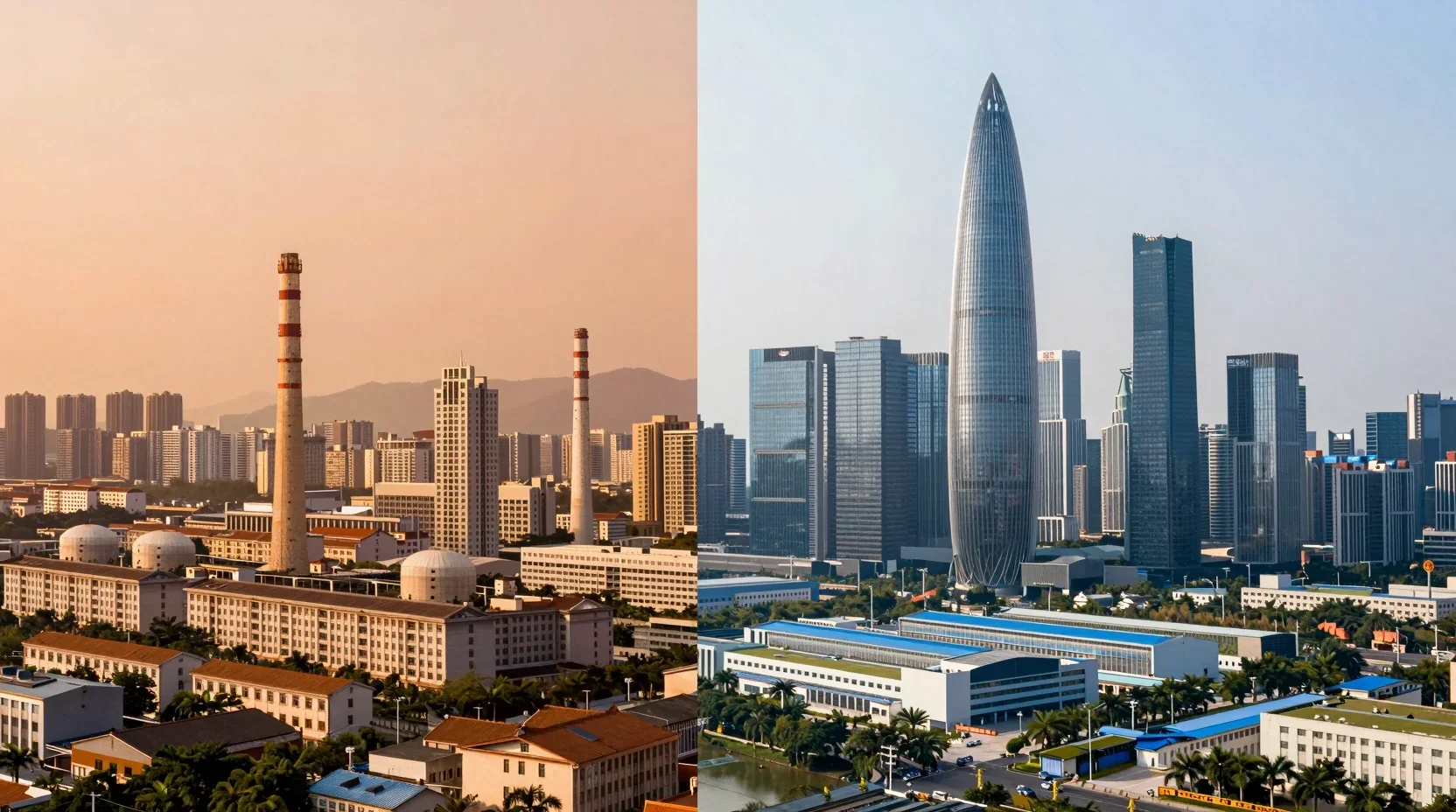
If you’re exploring clothing manufacturing in China, one question surfaces quickly: should you partner with a Guangzhou clothing factory or a Shenzhen clothing manufacturer? Both cities anchor the Pearl River Delta — the densest concentration of garment production on earth — and both house thousands of factories serving international fashion brands. But beneath the surface, each city offers distinct strengths that can shape your sourcing success.
Neither city wins on every front. The right China garment factory for your brand depends on product type, fabric needs, order volume, and growth stage. A Guangzhou clothing factory typically excels in traditional apparel with deep textile-market access and flexible minimums. A Shenzhen clothing manufacturer tends to lead in technical fabrics, sportswear production, and factory automation. Choosing well means matching your priorities with the manufacturing ecosystem that delivers the best results.
This guide compares Guangzhou and Shenzhen across the factors that matter most when sourcing clothing from China: manufacturing capabilities, cost and MOQ structures, fabric access, logistics, and ideal use cases. By the end, you’ll have a clear framework for selecting the right city — and the right factory — for your specific product line.
Оглавление
Industry Heritage: How Each City Developed
Understanding how each city’s garment industry evolved explains the sourcing advantages you’ll encounter today.
Guangzhou: China’s Oldest Textile and Apparel Hub
Guangzhou’s position as a textile powerhouse stretches back centuries. As the terminus of the ancient Maritime Silk Road and one of China’s most established trading ports, the city built deep expertise in fabrics and garment construction long before modern clothing manufacturing in China scaled up.
Today, a Guangzhou clothing factory operates within a mature ecosystem. Key manufacturing districts — Haizhu (home to the famous Zhongda Textile Market), Panyu, and Shiqi — concentrate thousands of apparel factories in Guangzhou alongside fabric wholesalers, trim suppliers, label makers, and dyeing houses. This density means a single Guangzhou garment factory can source every input — from raw cotton to custom-dyed zippers — within a short drive.
The city’s manufacturing character favors traditional apparel: woven shirts, denim, cotton basics, knitwear, and structured garments where skilled tailoring and hand-finishing add value. Decades of serving international brands have given Guangzhou factories a strong understanding of Western quality standards and export procedures.
Shenzhen: Technology-Driven Manufacturing
Shenzhen’s story begins in 1980 when the Chinese government designated it the country’s first Special Economic Zone. Unlike Guangzhou’s gradual evolution, Shenzhen was engineered as a modern manufacturing and technology center — and that DNA shapes its garment industry today.
A Shenzhen clothing manufacturer typically operates from newer facilities with more automated production lines, advanced cutting systems, and integrated quality-management technology. The city’s tech orientation extends to textiles: Shenzhen factories lead in moisture-wicking performance fabrics, compression materials, bonded seams, and technical construction methods that require precision equipment.
Shenzhen’s proximity to Hong Kong — roughly an hour by train — adds convenience for international buyers. Many brand owners fly into Hong Kong International Airport and cross into Shenzhen for factory visits, making the Shenzhen apparel production ecosystem especially accessible for first-time China clothing sourcing trips.
One Region, Two Specializations
The roughly 100-kilometer gap between Guangzhou and Shenzhen makes them complementary rather than competitive. Many brands partner with a Guangzhou clothing factory for certain product categories and a Shenzhen clothing manufacturer for others, leveraging the best of each hub within the broader Pearl River Delta manufacturing region.
Manufacturing Capabilities: What Each City Does Best
Choosing between a Guangzhou clothing factory and a Shenzhen clothing manufacturer starts with matching your product requirements to each city’s production strengths.
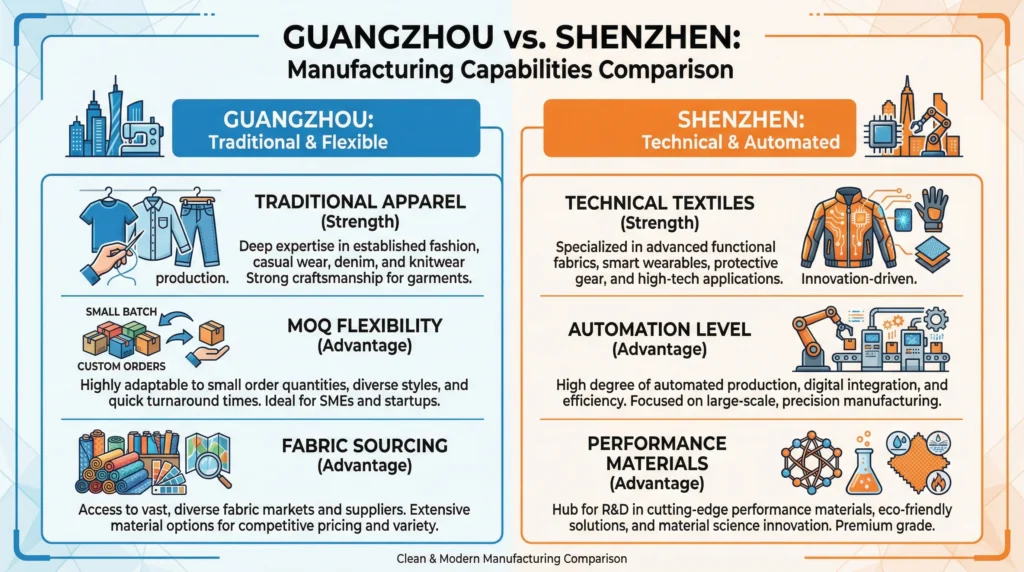
Guangzhou Clothing Factory Strengths
A typical Guangzhou garment factory specializes narrowly — one factory excels at denim, another at woven dress shirts, another at knit polos. This specialization creates a network of experts you can tap for different product lines. Core strengths include:
- Woven garments: Shirts, blouses, trousers, blazers, and structured pieces where construction skill drives quality.
- Denim: Guangzhou’s denim heritage includes raw fabric development, washing, distressing, and finishing processes perfected over decades.
- Cotton basics: T-shirts, underwear, and everyday essentials produced at competitive prices with strong fabric access.
- Traditional craftsmanship: Skilled tailors and seamstresses with years of experience in hand-finishing, intricate stitching, and pattern grading.
- Trim and component access: Buttons, zippers, woven labels, hangtags, and packaging sourced locally, reducing lead times and material costs.
If your brand centers on classic apparel categories where cut, construction, and fabric hand-feel define the product, a Guangzhou clothing factory likely offers the deepest capability pool.
Shenzhen Clothing Manufacturer Strengths
A Shenzhen clothing manufacturer tends to operate with newer equipment and a technology-forward mindset. Core strengths include:
- Technical and performance apparel: Sportswear, activewear, outdoor gear, and athleisure requiring engineered fabrics and precision construction.
- Advanced materials: Moisture-wicking, UV-protective, antimicrobial, and four-way stretch fabrics processed with specialized equipment.
- Automation and consistency: Automated cutting, laser finishing, and computerized sewing lines that improve consistency on large runs.
- Innovation orientation: Willingness to experiment with new materials, construction techniques, and product categories.
- Younger, tech-comfortable workforce: Production teams accustomed to digital workflows, CAD integration, and data-driven quality management.
If your line features performance fabrics, technical construction, or products that require modern machinery, Shenzhen apparel production offers a natural fit.
Quality: Factory-Level, Not City-Level
A critical point for anyone sourcing clothing from China: quality depends on individual factory management, not city geography. Both Guangzhou and Shenzhen house world-class China garment factories serving global luxury brands — and both contain lower-tier workshops with limited capability. When evaluating any Guangzhou clothing factory or Shenzhen clothing manufacturer, assess the specific facility’s certifications, client references, sample quality, and production track record. City location alone tells you about general specialization, not guaranteed quality.
Cost Structure and MOQ Comparison
Pricing and minimum order quantities shape which China garment factory is realistic for your brand’s stage and budget.
Guangzhou Clothing Factory: Cost Advantages
The mature supply chain and fierce competition among apparel factories in Guangzhou often produce favorable pricing for traditional garments:
- Lower labor costs: Guangzhou’s labor rates remain slightly below Shenzhen’s, translating to savings on labor-intensive construction — hand-finishing, complex stitching, multi-component assembly.
- Material cost savings: Direct access to the Zhongda Textile Market and hundreds of nearby fabric mills eliminates middleman markups. A Guangzhou garment factory can often source fabrics at 10–20% below prices available to factories purchasing through traders.
- Flexible MOQs: Many Guangzhou clothing factories accept orders of 200–500 units per style — sometimes lower for repeat customers or simpler products. This flexibility makes Guangzhou attractive for startups and emerging brands managing tight clothing manufacturing budgets.
- Competitive quoting: The sheer density of factories in Guangzhou creates pricing pressure. Obtaining three to five quotes for the same product is straightforward, and factories understand they compete on price.
Shenzhen Clothing Manufacturer: Cost Realities
Shenzhen apparel production typically carries higher base costs offset by productivity and quality advantages:
- Higher labor rates: Shenzhen’s status as a Special Economic Zone and technology hub drives wages above the Guangzhou average. This adds per-unit cost on labor-intensive products.
- Automation offsets: More automated production lines can offset higher labor costs through faster throughput and reduced error rates. For products suited to mechanized production, a Shenzhen clothing manufacturer may match or beat Guangzhou pricing on a total-cost basis.
- Higher MOQs: Shenzhen factories typically target 500–1,000 unit minimums per style, reflecting their orientation toward established brands with proven sales volume.
- Premium positioning: Many Shenzhen clothing manufacturers target mid-to-high-end brands willing to pay more for technical capability, consistent quality, and advanced production methods. If your product commands premium retail pricing, the higher factory cost may be justified.
Total Cost of Ownership
Unit price is only one variable. When comparing a Guangzhou clothing factory quote against a Shenzhen clothing manufacturer quote, factor in:
- Defect rates and rework costs — a cheaper factory that delivers 8% defects costs more than a pricier factory delivering 1%.
- Communication efficiency — factories with strong English-speaking teams reduce costly misunderstandings.
- Sample accuracy — more accurate first samples save money on development iterations.
- Logistics costs — minimal difference between the two cities, but verify port charges and inland transport fees.
Focus on total landed cost per sellable unit, not just the FOB price on a quote sheet.
Fabric and Material Sourcing in Guangzhou vs Shenzhen
Material access often determines what a China garment factory can produce — and how quickly. The sourcing environments in Guangzhou and Shenzhen differ significantly.
Guangzhou: China’s Textile Capital
Guangzhou dominates Chinese fabric sourcing, and this advantage directly benefits any Guangzhou clothing factory you partner with:
- Zhongda Textile Market: Over 200,000 square meters of wholesale fabric vendors in Haizhu District. Thousands of stalls sell cotton, linen, silk, denim, knits, and specialty fabrics. You can physically inspect, compare, and purchase materials in a single visit.
- Nearby mill clusters: Cotton mills in Foshan, denim mills in Xintang (the “Denim Capital of the World,” only 30 minutes from central Guangzhou), and knitting factories throughout the region supply raw materials to apparel factories in Guangzhou at competitive prices.
- Trim and accessory markets: Buttons, zippers, woven labels, hangtags, elastic, interfacing — all sourced within Guangzhou’s wholesale districts, reducing component lead times to days rather than weeks.
- Fabric development: Many Guangzhou garment factories maintain relationships with mills that can develop custom fabrics — unique weaves, custom-dyed colors, or proprietary blends — at MOQs accessible to smaller brands.
If your brand’s identity depends on distinctive fabrics and materials, the sourcing depth available to a Guangzhou clothing factory is hard to match.
Shenzhen: Technical and Performance Materials
Shenzhen clothing manufacturers access a different material ecosystem oriented toward innovation:
- Performance fabric suppliers: Mills producing moisture-wicking polyester, recycled nylon, four-way stretch blends, and antimicrobial-treated textiles cluster in and around Shenzhen.
- Technical material testing: Shenzhen’s technology infrastructure includes more materials-testing labs capable of verifying performance claims — UV protection ratings, moisture transport, abrasion resistance.
- Imported luxury fabrics: Trading companies in Shenzhen specialize in sourcing premium European and Japanese textiles for brands requiring imported materials produced in Chinese factories.
- Sustainable material access: Shenzhen’s innovation culture has attracted suppliers of recycled polyester, organic cotton certifications, and bio-based fabric alternatives faster than more traditional markets.
Hybrid Material Sourcing Strategy
Experienced brands often combine both cities’ material strengths. Source your cotton, denim, and commodity fabrics through a Guangzhou clothing factory’s local supply chain. Source technical performance fabrics and specialty materials through Shenzhen clothing manufacturer networks. This hybrid approach accesses the best material options in Pearl River Delta manufacturing while potentially reducing overall fabric costs.
Logistics, Ports, and Shipping
Efficient logistics move finished garments from your China garment factory to your warehouse. Both cities offer strong infrastructure, with minor differences worth understanding.
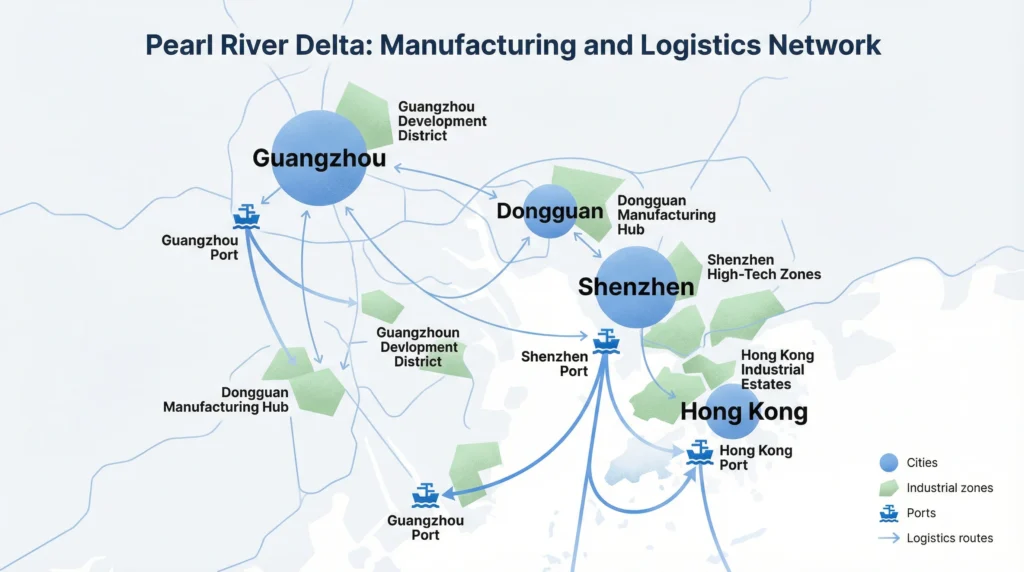
Guangzhou Logistics
- Port of Guangzhou and the expanded Nansha Port handle significant container volumes with competitive freight rates.
- Baiyun International Airport serves air freight needs for time-sensitive or sample shipments.
- Established freight forwarder network: Guangzhou’s long trading history means hundreds of experienced freight forwarders, customs brokers, and logistics companies compete for business — driving service quality up and costs down.
- Southeast Asian access: Guangzhou’s position makes it slightly more convenient for shipments to Southeast Asian markets.
Shenzhen Logistics
- Port of Shenzhen (Yantian and Shekou terminals) ranks among the world’s busiest and best-connected container ports — a major advantage for brands shipping globally.
- Shenzhen Bao’an Airport handles growing air freight volumes.
- Hong Kong International Airport is roughly one hour away, providing additional air freight capacity and routing options — especially valuable for express and courier shipments.
- Modern customs processes: Shenzhen’s SEZ status has driven more streamlined export documentation and customs clearance procedures.
Net Logistics Difference
For most brands, the shipping cost and transit-time difference between a Guangzhou clothing factory and a Shenzhen clothing manufacturer is negligible. Both cities connect to major global shipping routes through nearby deep-water ports. Unless your logistics strategy has very specific port or routing requirements, logistics alone shouldn’t determine your China clothing sourcing location.
Which City Should You Choose for Clothing Manufacturing?
Use this decision framework to match your brand’s needs with the right Pearl River Delta manufacturing hub.
Choose a Guangzhou Clothing Factory When:
- Your products are traditional apparel — woven shirts, denim, cotton basics, knitwear, or structured garments where tailoring skill matters most.
- Fabric sourcing flexibility is critical — you want direct access to China’s largest textile market and thousands of material options.
- You need lower MOQs — you’re a startup or emerging brand ordering 200–500 units per style and need factories willing to work at that scale.
- Budget optimization is a priority — competitive factory pricing and lower material costs help you manage your clothing manufacturing investment.
- You value specialist expertise — you want factories that focus on one garment category and have perfected their craft over decades.
Choose a Shenzhen Clothing Manufacturer When:
- Your products require technical fabrics — sportswear, activewear, outdoor apparel, or athleisure with performance material requirements.
- Automation and consistency matter — you need large-run precision that modern equipment delivers more reliably than manual production.
- You’re an established brand with volume — your order quantities meet 500–1,000 unit minimums, and you benefit from the per-unit economics of scaled production.
- Innovation is a differentiator — your brand competes on material technology, construction innovation, or technical performance features.
- Hong Kong access is convenient — you travel frequently and value the easy transit between Hong Kong and Shenzhen clothing manufacturer facilities.
Work with Both Cities When:
- Your product line spans multiple categories — basics and performance pieces require different factory specializations.
- You want manufacturing redundancy — backup factories in a second city protect against disruptions.
- You’re still exploring — visiting factories in both locations during a single sourcing trip lets you compare capabilities firsthand.
- Your sourcing strategy is evolving — as your brand grows, your manufacturing needs may shift from one city’s strengths to the other’s.
The roughly 100-kilometer distance between the cities means you can visit a Guangzhou clothing factory in the morning and tour a Shenzhen clothing manufacturer in the afternoon. Many international buyers plan three- to five-day sourcing trips that cover both hubs, developing relationships in each location.
How Algo Bert Fashion Helps You Source from the Right Factory
Choosing between a Guangzhou clothing factory and a Shenzhen clothing manufacturer requires on-the-ground expertise and verified factory relationships. At Algo Bert Fashion, we’ve spent years building our manufacturing network across both cities, and we help fashion brands connect with the right China garment factory for their specific products and budget.
Our team evaluates your product requirements — materials, construction complexity, order volume, quality standards — and matches them with factories whose proven capabilities align. Whether your brand benefits from Guangzhou apparel manufacturing strengths or Shenzhen apparel production advantages, we identify, vet, and manage factory relationships so you can focus on growing your brand.
Our Services:
- Manufacturing location strategy matched to your product line
- Verified factory identification in both Guangzhou and Shenzhen
- Sample development and production coordination
- In-line and final quality control inspections
- Pearl River Delta supply chain optimization
- Export documentation and shipping coordination
Explore our manufacturing services to find the right China garment factory for your brand.
FAQ: Guangzhou and Shenzhen Clothing Factory Questions
Is a Guangzhou clothing factory or Shenzhen manufacturer better for small brands?
A Guangzhou clothing factory generally offers more flexibility for small and emerging brands. Lower MOQs (often 200–500 units), competitive pricing on traditional garments, and extensive fabric-market access make Guangzhou the more accessible starting point for brands with limited order volume. Shenzhen clothing manufacturers tend to target larger orders, though small-brand-friendly factories do exist in both cities.
Can I visit Guangzhou and Shenzhen factories in one trip?
Yes. The two cities are approximately 100 kilometers apart, connected by high-speed rail (about 30 minutes) and highway. Most international buyers fly into Hong Kong, then visit factories in both cities over a three- to five-day trip. This makes it practical to compare a Guangzhou clothing factory and a Shenzhen clothing manufacturer for the same product before committing.
Which city has better quality for clothing manufacturing in China?
Quality depends on the individual China garment factory, not the city. Both Guangzhou and Shenzhen house factories that produce for global luxury labels and factories with limited capability. When evaluating any Guangzhou clothing factory or Shenzhen clothing manufacturer, assess factory certifications, client references, and sample quality rather than assuming city-level quality differences.
Is Guangzhou or Shenzhen better for denim manufacturing?
Guangzhou is the stronger choice for denim. The city’s denim heritage runs deep, with specialized Guangzhou garment factories handling raw denim development, washing, distressing, and finishing. Nearby Xintang — known as the “Denim Capital of the World” — is only 30 minutes from central Guangzhou, providing unmatched access to denim mills and processing facilities.
What about Dongguan — should I consider factories there too?
Dongguan sits between Guangzhou and Shenzhen and hosts a significant concentration of China garment factories, particularly for knitwear and casual apparel. It’s part of the same Pearl River Delta manufacturing ecosystem and worth considering during your sourcing evaluation, especially if your product overlaps with Dongguan’s knitwear and casual-wear specialization.
How do I verify a Guangzhou clothing factory before placing an order?
Verify any Guangzhou clothing factory through multiple steps: request and check business licenses, ask for client references and contact them, order paid samples before committing to bulk production, and consider a third-party factory audit. Platforms like Alibaba offer basic verification, but independent due diligence — ideally including an in-person visit or agent inspection — provides the strongest assurance before you commit manufacturing capital.
Are clothing manufacturing costs in China still competitive?
Yes. Despite rising wages in the Pearl River Delta, clothing manufacturing in China remains highly competitive due to supply chain density, infrastructure efficiency, and production-line productivity. A Guangzhou clothing factory or Shenzhen clothing manufacturer still offers strong value compared to most alternative manufacturing countries, particularly for orders requiring complex construction, diverse fabric options, or technical capabilities.
Conclusion
The Guangzhou vs Shenzhen debate isn’t about finding a single winner — it’s about matching your product requirements with each city’s manufacturing strengths within the world-class Pearl River Delta ecosystem.
For traditional apparel, fabric variety, flexible MOQs, and competitive pricing, a Guangzhou clothing factory typically delivers the best fit. For technical fabrics, performance apparel, automation-driven consistency, and innovation, a Shenzhen clothing manufacturer offers clear advantages. Many successful fashion brands leverage both cities, choosing the optimal China garment factory for each product category.
Regardless of location, sourcing success depends on the same fundamentals: thorough factory verification, detailed tech packs and communication, consistent quality control, and relationship building over time. With the right approach and the right partners, clothing manufacturing in China — whether in Guangzhou, Shenzhen, or both — gives your brand access to the world’s deepest and most capable garment production ecosystem.
Ready to find the right factory for your brand? Let Algo Bert Fashion connect you with verified Guangzhou clothing factories and Shenzhen clothing manufacturers matched to your products, volume, and quality standards.
Contact our team to discuss your manufacturing needs | Request a quote for your production
Related Posts:

 English (UK)
 Español
 Français
 Deutsch
 Português
 Italiano
 Polski
 Русский
 한국어
한국어