
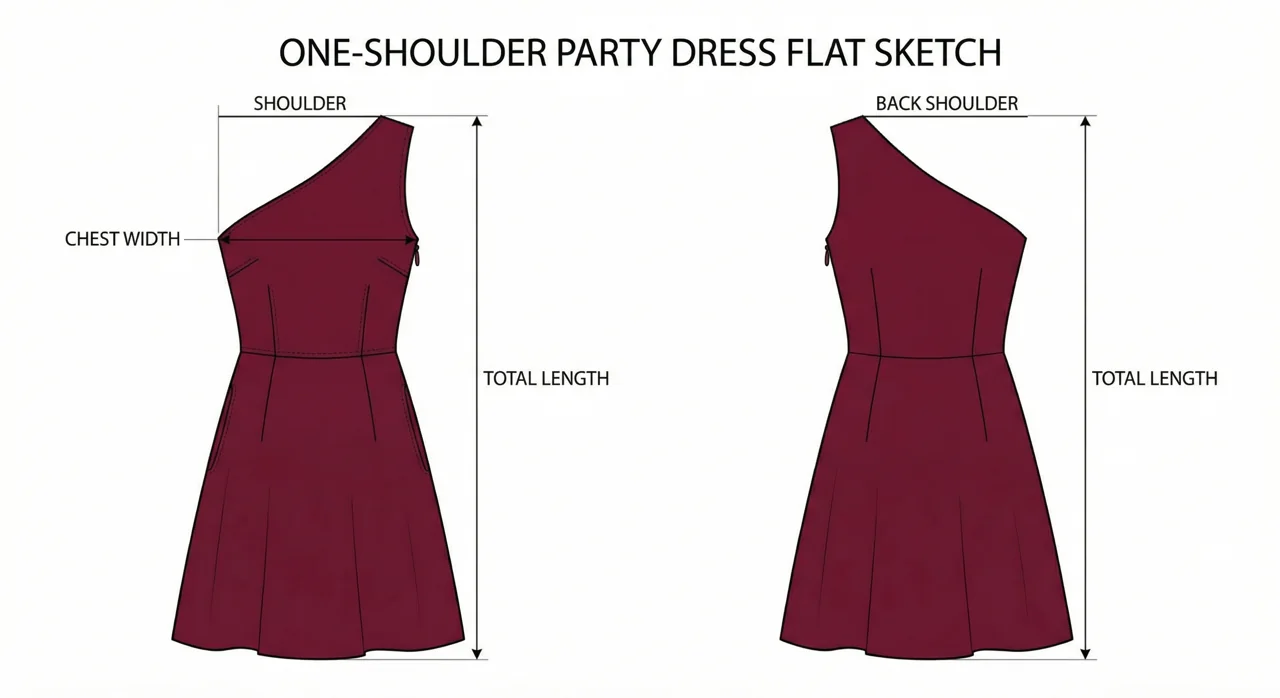
Creating a professional Bekleidungstechnikpaket is the single most important step in ensuring your designs translate accurately from concept to finished garment. Without a comprehensive clothing tech pack, you’re essentially asking factories to guess at your vision — leading to costly sample rejections, production delays, and communication breakdowns that can derail your entire collection launch.
In this guide, we walk you through the 7 essential steps for building a clothing tech pack that Chinese garment factories can execute flawlessly. Whether you’re a first-time brand owner or looking to professionalize your product development process, mastering the clothing tech pack creation process saves you thousands of dollars and weeks of frustrating back-and-forth with manufacturers.
What you’ll learn in this guide:
- What a clothing tech pack is and why every factory demands one
- The 7 essential components every professional clothing tech pack must include
- How to create measurement specs factories understand the first time
- Common clothing tech pack mistakes that cost brands thousands of dollars
- Free downloadable clothing tech pack template for immediate use
- Software tools and resources for creating professional tech packs
- When to hire a technical designer vs. building your clothing tech pack yourself
Inhaltsübersicht
What Is a Clothing Tech Pack and Why You Need One
A Bekleidungstechnikpaket (also called a technical package or specification sheet) is a comprehensive document that communicates every detail of your garment design to a clothing factory. Think of it as the blueprint for your product — the detailed instruction set that transforms your creative vision into a physical garment a factory can produce consistently and accurately.
Without a proper clothing tech pack, you’re playing a game of telephone with your manufacturer. You describe your design verbally or through rough sketches, they interpret it based on their own experience, and the sample that comes back rarely matches what you envisioned. This miscommunication costs new clothing brands thousands of dollars in:
- Rejected sample costs ($100–300 per round of revisions)
- Production delays (2–4 weeks per additional revision cycle)
- Lost sales opportunities (missing critical launch windows)
- Damaged factory relationships (frustration and lost trust on both sides)
Why Factories Require a Clothing Tech Pack
Chinese garment manufacturers work with dozens — sometimes hundreds — of clients simultaneously. They don’t have the time or resources to interpret vague descriptions or guess at your design intentions. A professional clothing tech pack serves several critical functions:
Eliminates Guesswork: Every measurement, material, and construction detail is specified precisely. The factory knows exactly what to produce without relying on interpretation.
Provides Pricing Accuracy: Factories can only quote accurately when they have exact specifications. Vague requests lead to inflated quotes (factories pad prices to cover unknowns) or under-quoting followed by surprise price increases later.
Enables Quality Control: Your clothing tech pack becomes the objective standard against which samples and production runs are evaluated. Without it, you have no measurable basis for accepting or rejecting factory work.
Reduces Language Barrier Errors: Written specifications in a standardized format minimize miscommunication caused by language differences and create a permanent reference document both parties can consult at any point during production.
Protects Your Intellectual Property: A detailed clothing tech pack documents your original design, which can be important for IP protection and for working with multiple factories simultaneously. According to WIPO’s guidelines on fashion IP, proper documentation is the first step in protecting original designs.
When You Need a Clothing Tech Pack
You need a clothing tech pack before contacting any factory for sampling or production. Specifically:
- Before requesting quotes: Factories need complete specifications to provide accurate pricing
- Before sampling: Your clothing tech pack guides the entire sample creation process
- Before production: Every production run requires an approved clothing tech pack as the manufacturing standard
- For every unique style: Each garment style requires its own clothing tech pack
Step 1: Build the Foundation of Your Clothing Tech Pack
Every professional clothing tech pack starts with a well-organized cover page that provides essential administrative information helping factories organize, track, and manage your order efficiently.
Required Elements for Your Clothing Tech Pack Cover Page:
- Style Number: A unique identifier for each garment (e.g., SS26-TSH-001)
- Style Name: A descriptive name (e.g., “Classic Crew Neck T-Shirt”)
- Season/Collection: When this item will be sold (e.g., Spring/Summer 2026)
- Designer/Brand Name: Your company and contact information
- Date Created: When the clothing tech pack was finalized
- Revision Number: Track all changes (Rev 1, Rev 2, Rev 3, etc.)
- Factory Name: Which factory will produce this garment
- Size Range: All available sizes (XS–3XL, 0–14, etc.)
Profi-Tipp: Create a consistent style numbering system that encodes useful information. For example: SS26 (Spring/Summer 2026) – TSH (T-shirt category) – 001 (sequential number). This system keeps your clothing tech pack library organized as your collection grows.
Step 2: Create Flat Sketches for Your Clothing Tech Pack
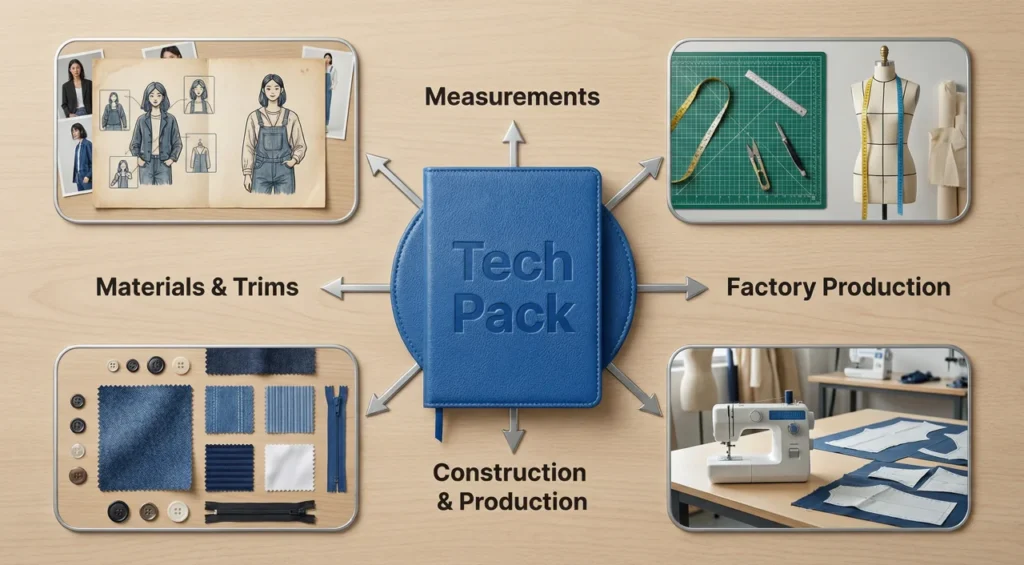
Flat sketches are the visual backbone of every clothing tech pack. These technical drawings show your garment laid flat, displaying both front and back views with precise construction details. Unlike fashion illustrations — which focus on artistic expression, drape, and movement — flat sketches in a clothing tech pack focus entirely on construction accuracy.
Requirements for Professional Flat Sketches in a Clothing Tech Pack:
- Front and Back Views: Always include both perspectives
- Accurate Proportions: Drawn proportionally (doesn’t need to be full-scale, but proportions must be precise)
- Construction Details: Clearly show all seams, pockets, closures, and stitching types
- Callouts: Use leader lines pointing to specific features with brief technical descriptions
- Clean Vector Lines: Use vector graphics (Adobe Illustrator or similar) for crisp, unambiguous lines
- Color/Texture Indication: Can be colored or black and white but should indicate the fabric type
Common Mistake: Many beginners submit fashion illustrations instead of flat sketches in their clothing tech pack. Fashion illustrations look beautiful but tell factories very little about how to actually construct the garment. Factories need flat sketches that show seams, stitching, and structural details.
Step 3: Develop Measurement Specs for Your Clothing Tech Pack
The measurement specification sheet — commonly called a “spec sheet” — is the most technically critical section of any clothing tech pack. It lists every measurement point on the garment with precise dimensions for each size in your range.
Standard Measurement Points by Garment Type
Tops/Shirts (Include in Your Clothing Tech Pack):
- Chest/Bust (1″ below armhole)
- Waist
- Bottom Hem Width
- Shoulder Width (seam to seam)
- Sleeve Length
- Sleeve Opening
- Neck Width
- Front/Back Body Length (HPS to hem)
Pants/Bottoms (Include in Your Clothing Tech Pack):
- Waist (relaxed and stretched, if elastic)
- Hip (8″ below waist)
- Thigh (1″ below crotch)
- Knee Width
- Leg Opening
- Inseam
- Outseam
- Front Rise / Back Rise
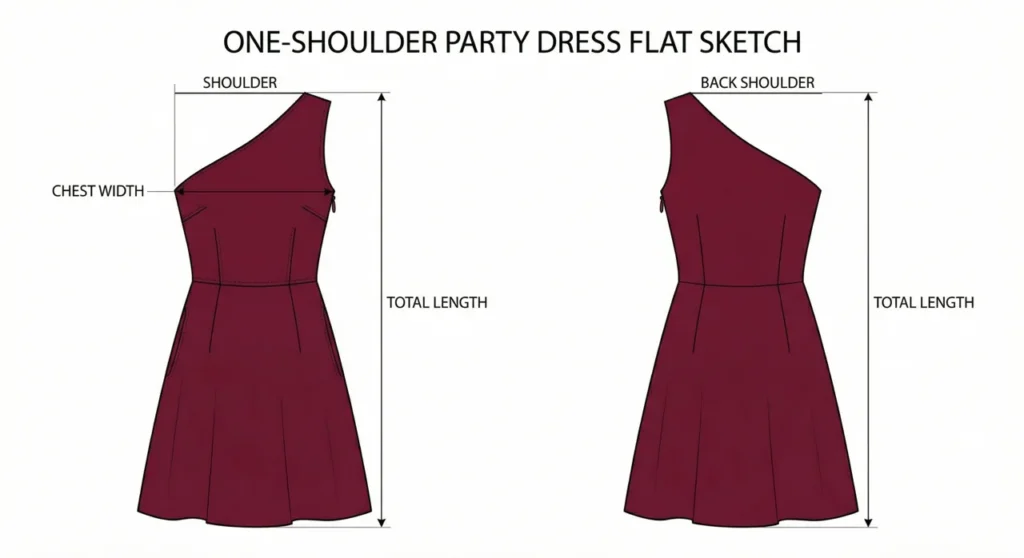
Dresses (Include in Your Clothing Tech Pack):
- Chest/Bust
- Waist
- Hip
- Total Length (shoulder to hem)
- Sleeve Length (if applicable)
Critical Elements of Every Clothing Tech Pack Spec Sheet
- Point of Measurement (POM): A clear written description of exactly where each measurement is taken
- Base Size Measurements: Usually size Medium or size 8
- Grade Rules: How much each measurement increases or decreases between adjacent sizes
- Tolerance: Acceptable variation range (typically +/– 0.5″ for most measurements)
- Unit of Measure: Specify inches or centimeters (metric is standard with Chinese factories)
Example Spec Sheet Format for a Clothing Tech Pack
| POM | Beschreibung | XS | S | M | L | XL | Tolerance |
|---|---|---|---|---|---|---|---|
| A | Chest (1″ below armhole) | 18″ | 19″ | 20″ | 21″ | 22″ | +/– 0.5″ |
| B | Body Length (HPS) | 26″ | 27″ | 28″ | 29″ | 30″ | +/– 0.5″ |
| C | Sleeve Length | 7″ | 7.5″ | 8″ | 8.5″ | 9″ | +/– 0.25″ |
| D | Shoulder Width | 15″ | 15.5″ | 16″ | 16.5″ | 17″ | +/– 0.25″ |
| E | Bottom Hem Width | 18″ | 19″ | 20″ | 21″ | 22″ | +/– 0.5″ |

Step 4: Complete the Bill of Materials in Your Clothing Tech Pack
The Bill of Materials (BOM) section of your clothing tech pack lists every single component needed to manufacture the garment — from the main shell fabric down to the smallest thread and label.
BOM Categories for a Complete Clothing Tech Pack
Fabrics:
- Shell / main fabric (specify GSM weight, fiber composition, color)
- Lining fabric (if applicable)
- Interfacing
- Trim or contrast fabrics
Hardware and Trims:
- Buttons (size, material, color, quantity per garment)
- Zippers (length, type, teeth material, color)
- Hooks and eyes
- Snaps or press studs
- Drawstrings and drawcord hardware
- Elastic (width, type, stretch percentage)
Labels and Tags:
- Main brand label (woven or printed, size, content)
- Size label
- Care instruction / content label
- Hangtag and barcode tag
- Price ticket
- Security tags (if required)
Thread:
- Thread color(s) with reference numbers
- Thread type (polyester core-spun, cotton, etc.)
Packaging:
- Polybag specifications (size, mil thickness, warning text)
- Carton markings and dimensions
- Tissue paper, stickers, or branded inserts
BOM Format Example for a Clothing Tech Pack
| Item | Beschreibung | Supplier | Farbe | Qty per Garment |
|---|---|---|---|---|
| Fabric – Shell | 100% Cotton Jersey, 180 GSM | Main supplier | White | 0.8 yards |
| Button | 15mm Corozo, 4-hole | Button supplier | Natural | 6 pieces |
| Label – Main | Woven label, 2″ × 1″ | Label supplier | Benutzerdefiniert | 1 piece |
| Label – Care | Printed satin, 1.5″ × 3″ | Label supplier | White | 1 piece |
| Thread | Polyester core-spun, Tex 40 | Thread supplier | White (#001) | 0.05 lbs |
| Polybag | 12″ × 16″, 1.5 mil, with warning | Packaging supplier | Clear | 1 piece |
Step 5: Define Construction Details in Your Clothing Tech Pack
The construction details section of your clothing tech pack explains exactly how the garment is assembled — specifying sewing techniques, seam types, and finishing methods the factory must follow.
Common Construction Specifications in a Clothing Tech Pack
Seam Types:
- Plain seam (standard, pressed open or closed)
- French seam (enclosed, for lightweight fabrics)
- Flat-felled seam (durable, for denim and sportswear)
- Overlocked/serged edge (for knit fabrics)
- Bound seam (for unlined jackets)
Hem Finishes:
- Double-needle hem (standard for t-shirts)
- Coverstitch hem (stretch-friendly for knits)
- Rolled hem (for lightweight wovens)
- Blind hem (for formal wear)
- Raw edge (intentional, for contemporary styling)
Stitch Types:
- Single needle lockstitch
- Double needle lockstitch
- Chain stitch
- Cover stitch
- Bartack (for reinforcement at stress points)
Construction Callouts in Your Clothing Tech Pack Should Include:
- Pocket construction method and exact placement measurements
- Collar attachment method and specifications
- Cuff finishing details
- Placket construction (for button-front garments)
- Lining attachment points (if applicable)
- Reinforcement stitching locations and bartack positions
Profi-Tipp: Reference comparable garments from well-known brands as construction examples within your clothing tech pack. Writing “Construct collar similar to Uniqlo Oxford shirt” provides the factory with a tangible, accessible reference point.
Step 6: Add Colorways and Artwork to Your Clothing Tech Pack
Most clothing brands produce garments in multiple color options and may include prints, embroidery, or other decorative artwork. The colorway and artwork section of your clothing tech pack ensures visual accuracy across all variations.
Colorway Specifications for Your Clothing Tech Pack
For each color variation, include:
- Color Name: Your internal marketing name (e.g., “Ocean Blue”)
- Pantone Reference: Use Pantone TCX for textiles (e.g., Pantone 19-4052 TCX)
- Color Swatch: Physical swatch or high-resolution digital reference
- Lab Dip Approval: Specify whether lab dip approval is required before bulk fabric dyeing
Artwork Specifications for Your Clothing Tech Pack
For prints, embroidery, patches, or appliqués, include:
- Artwork File: Vector file (.ai or .eps) or high-resolution raster (.png/.tif at 300+ DPI)
- Exact Placement: Precise measurements from reference points (e.g., “Centered horizontally, top edge 3″ below neckline seam”)
- Finished Size: Exact dimensions of the printed or embroidered artwork
- Colors: Every color used in the artwork with individual Pantone references
- Technique: Screen print, DTG, embroidery, heat transfer, sublimation, etc.
- Quality Standards: Thread count for embroidery, ink opacity for prints, wash durability requirements

Step 7: Finalize Packing Instructions in Your Clothing Tech Pack
While often overlooked, clear packing and shipping instructions in your clothing tech pack prevent costly mistakes during the final production stages.
Packing Specifications for Your Clothing Tech Pack
- Folding Method: Diagram or reference photograph showing exactly how the garment should be folded
- Polybag Specifications: Size, mil thickness, suffocation warning text requirements (required by ASTM D3951 and most retailers)
- Carton Marking: Everything that should be printed on each shipping carton exterior
- Size Ratio: How many of each size per carton (e.g., “2-4-4-2” for XS-S-M-L)
- Carton Dimensions: Maximum weight and size restrictions for your logistics provider
- Hangtag Application: Exactly how and where hangtags should be attached to the garment
Standard Carton Markings for Your Clothing Tech Pack
- Supplier / Factory name
- Customer / Brand name
- Style number and garment description
- Color name and reference
- Size and size ratio per carton
- Quantity per carton
- Gross weight and net weight
- Carton number (e.g., Carton 1 of 50)
- Country of origin
- Shipping marks (if provided by your freight forwarder)
Clothing Tech Pack Measurement Mastery
Creating measurement specifications that Chinese factories can execute correctly requires understanding standardized measurement techniques and providing information in formats factories expect.
Standard Measurement Process for a Clothing Tech Pack
Professional factories use standardized measurement techniques — typically based on ASTM D5585 or equivalent standards — to ensure consistency across production runs.
Key Principles:
- Garment Laid Flat: All measurements are taken with the garment laid flat on a measurement table — never on a body or mannequin
- No Stretching: Fabric must be relaxed, not stretched or compressed during measurement
- Consistent Reference Points: Measurements are always taken from identical reference points across all sizes
- Multiple Measurements Averaged: Critical measurements are taken on multiple production samples and averaged for accuracy
Creating Size Grades for Your Clothing Tech Pack
Size grading scales your base size measurements up and down to create your full size range. Consistent grade rules ensure proportional sizing across all sizes in your clothing tech pack.
Standard Grade Rules for Adult Tops:
| Measurement | Grade Between Sizes |
|---|---|
| Chest | +1″ per size |
| Waist | +1″ per size |
| Hip | +1″ per size |
| Body Length | +0.5″ per size |
| Sleeve Length | +0.5″ per size |
| Shoulder Width | +0.5″ per size |
| Neck Width | +0.25″ per size |
Standard Grade Rules for Adult Bottoms:
| Measurement | Grade Between Sizes |
|---|---|
| Waist | +1″ per size |
| Hip | +1″ per size |
| Inseam | +0.5″ per size (or constant) |
| Outseam | +0.5″ per size |
| Thigh | +0.5″ per size |
| Leg Opening | +0.5″ per size |
Profi-Tipp: If you don’t have established grade rules, most factories can provide standard grading based on your base size sample. However, you must review their proposed grades carefully to ensure they match your brand’s fit standards before including them in your clothing tech pack.
Measurement Tolerances in Your Clothing Tech Pack
Tolerances specify the acceptable range of variation for each measurement. Setting realistic tolerances in your clothing tech pack prevents unnecessary rejections while maintaining your quality standards.
Standard Tolerances:
- Chest, waist, hip: +/– 0.5″ to 0.75″
- Body length: +/– 0.5″ to 1″
- Sleeve length: +/– 0.25″ to 0.5″
- Shoulder width: +/– 0.25″ to 0.5″
- Neck width: +/– 0.25″
Factors That Affect Tolerances in a Clothing Tech Pack:
- Fabric Type: Knit fabrics require wider tolerances than wovens due to inherent stretch
- Garment Type: Casual wear allows wider tolerances than tailored or formal garments
- Price Point: Budget garments typically have wider tolerances than premium products
- Pre-Shrinkage: Pre-shrunk fabrics allow tighter tolerances than untreated materials
Common Clothing Tech Pack Mistakes That Cost You Money
After reviewing hundreds of clothing tech packs from new brands, we’ve identified the most common — and most expensive — mistakes that lead to production problems, wasted money, and missed launch dates.
Mistake 1: Incomplete or Missing Measurements
The Problem: A clothing tech pack with only 3–4 measurements when the garment requires 15–20 measurement points. Factories are forced to guess at critical dimensions.
The Cost: Multiple sample revision rounds ($100–300 each), production delays (2–4 weeks per round), and potential customer delivery delays.
The Fix: Use a comprehensive measurement template that includes all standard measurement points for your garment type. When in doubt, include more measurements rather than fewer in your clothing tech pack.
Mistake 2: Inconsistent Grade Rules
The Problem: Measurements don’t scale logically between sizes. The chest grades +1″ between S and M but jumps +2″ between M and L without explanation.
The Cost: Size inconsistencies across your range, customer fit complaints, and increased return rates.
The Fix: Create a grade rule table first, then apply those rules mathematically to generate all size measurements. Use spreadsheet formulas to ensure consistency across your clothing tech pack.
Mistake 3: Vague Construction Descriptions
The Problem: Using subjective terms like “professional finish” or “high-quality construction” without specifying exactly what those terms mean technically.
The Cost: Factories interpret “quality” based on their own standards, which may differ significantly from yours. You receive samples that don’t match your expectations.
The Fix: Reference specific techniques in your clothing tech pack: “Use 3-thread overlock for all internal seam finishing” or “Hem must be coverstitched with 2 needles at 3/8″ width.” Include reference photos of acceptable construction.
Mistake 4: Missing Pantone Color References
The Problem: Describing colors with vague words like “navy blue” or “light gray” in the clothing tech pack without providing Pantone or physical swatch references.
The Cost: Color mismatches between samples, between production batches, or between different garment components (fabric vs. thread vs. buttons).
The Fix: Always provide Pantone TCX references for all textile colors in your clothing tech pack. If exact Pantone matching isn’t feasible, send a physical fabric swatch that the factory can match against visually.
Mistake 5: Unclear Artwork Placement
The Problem: Writing “print on front chest” in the clothing tech pack without specifying exact measurements from defined reference points.
The Cost: Logo prints placed too high, too low, off-center, or at the wrong size. Each correction requires a new sample round.
The Fix: Provide exact measurements from clearly defined reference points: “Center artwork horizontally on front body. Top edge of artwork positioned 3″ below neckline seam, measured at center front.” Include a placement mockup in the clothing tech pack.
Mistake 6: Incorrect or Incomplete BOM
The Problem: The BOM in the clothing tech pack lists items without sufficient detail (e.g., “buttons” with no size, material, or color) or omits components entirely.
The Cost: Factories substitute materials to fill gaps, producing garments that don’t match your vision. Last-minute component sourcing causes production delays.
The Fix: Examine every component on a physical prototype and list each one in your clothing tech pack BOM with full specifications, including quantity per garment.
Mistake 7: Unrealistic Tolerances
The Problem: Demanding tolerances tighter than industry standards (e.g., +/– 0.25″ on all measurements) in the clothing tech pack.
The Cost: Higher factory quotes (tight tolerances cost more to achieve), increased rejection rates during QC, and adversarial factory relationships.
The Fix: Research industry-standard tolerances for your product type and price point. Set critical measurements tighter and allow standard variation on less critical areas in your clothing tech pack.
Mistake 8: Not Specifying Fabric Testing Requirements
The Problem: Assuming fabric quality without specifying required tests (colorfastness, shrinkage, pilling resistance) in the clothing tech pack.
The Cost: Production fabric that shrinks excessively, fades after washing, or pills prematurely — leading to customer complaints, returns, and brand damage.
The Fix: Specify all required fabric tests in your clothing tech pack. Standard tests include: colorfastness to washing (ISO 105-C06), colorfastness to light, dimensional stability / shrinkage, and pilling resistance.
Best Software for Creating a Clothing Tech Pack
While you can create a clothing tech pack using basic software like Microsoft Excel or Google Sheets, specialized tools can streamline the process and improve the professionalism of your output.
Adobe Illustrator — Industry Standard for Clothing Tech Pack Sketches
Best For: Brands with in-house design teams who create their own flat sketches
Pros:
- Industry-standard software for flat sketch creation
- Precise vector graphics that export cleanly
- Extensive libraries of garment templates available online
- Exports to every format factories accept
Cons:
- Significant learning curve for non-designers
- Subscription cost adds up over time
Kosten: $20.99/month (single app) or $54.99/month (full Creative Suite)
Techpacker — Purpose-Built Clothing Tech Pack Software
Best For: Small to medium brands wanting professional clothing tech packs without design software expertise
Pros:
- Built specifically for creating clothing tech packs
- Pre-built templates and component libraries
- Team collaboration features
- Automatic version control and revision tracking
Cons:
- Monthly subscription cost
- Limited sketching capabilities (you still need flat sketches from Illustrator or a freelancer)
Kosten: $29–99/month depending on plan and team size
Backbone PLM — Product Lifecycle Management
Best For: Growing brands managing multiple products, seasons, and team members
Pros:
- Comprehensive PLM system that goes beyond the clothing tech pack
- Component libraries and tech pack creation
- Line planning, calendar management, and costing tools
- Supplier collaboration portal
Cons:
- Higher cost than standalone tech pack tools
- Implementation time required
- May be overkill for brands with fewer than 20 styles
Kosten: Custom pricing (typically $500+/month for small teams)
Excel / Google Sheets — Budget-Friendly Option
Best For: Startups and small brands creating their first clothing tech packs
Pros:
- Free (Google Sheets) or included with Microsoft 365
- Flexible and fully customizable
- Easy to share with factories (universal format)
- No learning curve for basic users
Cons:
- No built-in design or sketching tools
- Manual formatting required for professional appearance
- Version control is manual and error-prone
- Limited collaboration features compared to specialized platforms
Kosten: Free (Google Sheets) or included with Microsoft Office
Our Recommendation for Clothing Tech Pack Software
For most startups and small brands, we recommend a phased approach:
- Start with Excel or Google Sheets using our free clothing tech pack template — $0/month
- Add Adobe Illustrator when you need to create professional flat sketches — $20.99/month
- Upgrade to Techpacker when you’re managing 10+ styles simultaneously — $29/month
- Consider Backbone PLM when you have 5+ team members and 50+ styles per season
Hiring a Technical Designer for Your Clothing Tech Pack
If creating a clothing tech pack yourself feels overwhelming — or if your first attempts produced poor factory results — hiring a freelance technical designer is a smart investment that typically pays for itself within one or two production cycles.
What Does a Technical Designer Do?
A technical designer bridges the gap between creative design and production execution. Specifically, they:
- Create professional flat sketches from your design concepts or reference images
- Develop complete measurement specifications and grade rules
- Build production-ready clothing tech packs formatted for factory submission
- Review factory samples and provide detailed fit comments
- Communicate technical requirements directly with your factory
- Ensure your designs are production-ready and cost-efficient
When to Hire a Technical Designer
Hire a technical designer if:
- You have design concepts but lack technical garment knowledge
- Your samples consistently don’t match your creative vision
- You’re struggling to communicate technical details with factories
- You’re launching a new product category you haven’t manufactured before
- You need to scale production beyond what you can manage yourself
You might not need one if:
- You have formal fashion design education with technical training
- You’re producing very simple, straightforward styles
- You have time to learn and iterate on your clothing tech pack skills
- Your factory provides robust technical design services
Where to Find Technical Designers
Freelance Platforms:
- Upwork (search “technical fashion designer” or “clothing tech pack”)
- Fiverr (search “tech pack designer” or “garment spec sheet”)
- LinkedIn (search “technical designer fashion”)
Industry-Specific Resources:
- Fashion industry job boards (StyleCareers, CFDA)
- Referrals from other brand owners in your network
- Fashion design school alumni networks
Technical Designer Costs and Budgeting
Typical Hourly Rates:
- Entry Level: $15–30/hour
- Mid-Level: $30–60/hour
- Senior / Expert: $60–100/hour
Per-Project Clothing Tech Pack Rates:
- Simple clothing tech pack (basic t-shirt, tank): $150–300
- Complex clothing tech pack (jacket, tailored pants): $300–600
- Full collection (10 styles): $2,000–5,000
Unsere Empfehlung: For most startups, budgeting 100–300) and preventing production errors that can cost thousands.
Working Effectively with a Technical Designer
Provide Clear Creative Briefs:
- Reference garments or inspiration images
- Your physical prototype sample (if available)
- Fabric swatches or detailed fabric specifications
- Specific construction requirements or preferences
- Your brand’s fit standards and target customer body type
Establish an Efficient Process:
- Initial Consultation: Discuss your design, brand standards, and requirements
- Draft Clothing Tech Pack: Designer creates the first version for your review
- Review and Feedback: You provide specific, actionable comments and revisions
- Final Clothing Tech Pack: Designer delivers the completed, factory-ready document
- Sample Review: Designer evaluates factory samples against the clothing tech pack
Communication Tips:
- Share examples of clothing tech packs whose format and detail level you admire
- Be specific in your feedback (“move the pocket up 1 inch” — not “make it look better”)
- Establish project timelines and milestone dates upfront
- Clarify revision policies (how many rounds are included in the project fee)
FAQ: Clothing Tech Pack Questions Answered
What is a clothing tech pack?
A clothing tech pack (technical package) is a comprehensive document that communicates every detail of a garment design to a clothing factory. It includes flat sketches, measurement specifications, a materials list (BOM), construction details, colorway references, and quality standards. The clothing tech pack serves as the manufacturing blueprint, ensuring factories produce exactly what the designer envisioned without guesswork or interpretation errors.
How much does a clothing tech pack cost to create?
The cost of creating a clothing tech pack varies based on complexity and who creates it:
- DIY: $0–50 (software and tools only, plus your time)
- Freelance Technical Designer: $150–600 per style
- Design Agency: $500–2,000 per style
The investment in a quality clothing tech pack pays for itself by reducing sample revision rounds (each costing $100–300) and preventing expensive production errors.
Can I create a clothing tech pack myself?
Yes, you can create a clothing tech pack yourself, especially if you have basic computer skills, are willing to learn technical garment terminology, and are producing relatively simple garment styles. Use our free template to organize all required information, and study examples of professional clothing tech packs to understand the expected format and detail level.
Consider hiring a professional when: You’re manufacturing complex garments, running your first production, or when previous DIY attempts resulted in factory miscommunication.
What software is best for creating a clothing tech pack?
The best software for creating a clothing tech pack depends on your skills, budget, and production volume:
- Beginners: Excel or Google Sheets with our free template (free)
- Design-Focused Brands: Adobe Illustrator for flat sketches ($20.99/month)
- Growing Brands: Techpacker for cloud-based clothing tech pack management ($29–99/month)
- Scaling Brands: Backbone PLM for full product lifecycle management (custom pricing)
Start simple and upgrade as your production needs grow.
How detailed should a clothing tech pack be?
A clothing tech pack should be detailed enough that a factory can produce your garment without asking clarifying questions. Essential details include 15–20 measurement points with tolerances, a complete BOM with specifications, clear construction descriptions, Pantone references for all colors, and exact artwork placement measurements.
Rule of Thumb: If you’re wondering whether to include a detail in your clothing tech pack, include it. Every missing detail is an opportunity for factory interpretation — and potential error.
Do I need a separate clothing tech pack for every style?
Yes, every unique garment style requires its own clothing tech pack. However, you can create “parent” and “child” versions for style variations:
- Full Clothing Tech Pack Required: Different garment types, different fits or silhouettes, significantly different construction
- Modified Parent Clothing Tech Pack: Same style in different colors, same style with different prints, minor modifications (pocket style, hem length)
Efficiency Tip: Create a master clothing tech pack for your base style, then create derivative versions noting only the specific changes.
How long does it take to create a clothing tech pack?
Time required depends on garment complexity and your experience:
- Simple styles (t-shirt, basic tank): DIY 2–4 hours | Professional 1–2 hours
- Medium complexity (button-down, simple dress): DIY 4–6 hours | Professional 2–3 hours
- Complex styles (jacket, tailored pants): DIY 6–10 hours | Professional 4–6 hours
Allow 2–3× longer for your first clothing tech pack as you learn the process. Each subsequent one becomes significantly faster.
Can factories create a clothing tech pack for me?
Some factories offer clothing tech pack creation services, but this approach carries significant risks:
- Conflict of Interest: The factory may design around their capabilities rather than your vision
- IP Concerns: The factory gains complete knowledge of your proprietary design
- Factory Dependency: You’re locked into using that specific factory
- Quality Variation: Different factories create clothing tech packs to different standards
Unsere Empfehlung: Create your own clothing tech pack or hire an independent technical designer. This maintains full control of your designs and allows you to work with any factory. Use factories for what they do best — manufacturing — not product development.
What’s the difference between a clothing tech pack and a spec sheet?
A clothing tech pack is the complete document containing all information needed to produce a garment. A spec sheet is one specific section of the clothing tech pack that focuses exclusively on measurements.
A clothing tech pack includes: Cover page, flat sketches, spec sheet, BOM, construction details, colorways, artwork placement, and packing instructions.
A spec sheet includes: Measurement points, dimensions per size, grade rules, and tolerances.
Think of the spec sheet as one chapter within the clothing tech pack “book.”
Conclusion: Your Clothing Tech Pack Is Your Most Powerful Manufacturing Tool
Creating a professional clothing tech pack is the most valuable skill any clothing brand owner can develop. While it requires an upfront investment of time or money, the return on that investment compounds with every production run through:
- Faster sample approvals (fewer rounds of costly revisions)
- Lower development costs (fewer rejected samples and wasted materials)
- Stronger factory relationships (clear communication builds trust)
- Higher production quality (objective quality standards eliminate guesswork)
- Fewer production errors (comprehensive specifications prevent misinterpretation)
Whether you choose to create your clothing tech pack yourself using our free template or hire a professional technical designer, the key is ensuring your factories receive complete, clear, and precise information. Every detail you include in your clothing tech pack is a potential error prevented — and a potential dollar saved.
Ready to create your first clothing tech pack? Download our free template and start building your manufacturing blueprint today. Your clothing tech pack is the bridge between your creative vision and the finished garments your customers will wear — invest the time to build that bridge properly.
Need expert help with your clothing tech pack? Kontakt Algo Bert Fashion for professional tech pack creation services, manufacturing consultation, or factory recommendations. Our Guangzhou-based team has created clothing tech packs for hundreds of styles across every garment category.
Erhalten Sie eine kostenlose Beratung → | Produktionsangebot anfordern →
Verwandte Ressourcen:


 English (UK)
 Español
 Français
 Deutsch
 Português
 Italiano
 Polski
 Русский
 한국어
한국어