
Poor quality can destroy your clothing brand faster than almost any other factor. One batch of defective products reaching customers triggers returns, negative reviews, and permanent reputation damage that can take years to repair. That’s why implementing robust clothing quality control isn’t optional — it’s essential for survival in the competitive fashion industry.
Yet many new brand owners approach clothing quality control reactively, dealing with problems only after defective garments reach their customers. This costly approach results in chargebacks, inventory write-offs, and lost customer trust. The brands that succeed long-term implement proactive clothing quality control from day one — preventing defects before they ever leave the factory floor.
In this comprehensive guide, we’ll show you exactly how to implement professional-grade clothing quality control for your garment production. From understanding inspection types and AQL inspection standards to building a complete garment inspection checklist, you’ll learn the systems successful brands use to maintain consistent quality. Whether you’re placing your first order or scaling production across multiple factories, mastering clothing quality control protects both your investment and your reputation.
What you’ll master in this guide:
- The 9 essential clothing quality control checks every brand must implement
- How to use AQL inspection standards effectively for different product types
- Complete garment inspection checklists for every major garment category
- How to identify common clothing manufacturing defects before they ship
- How to handle quality failures with factories diplomatically and effectively
- Free downloadable clothing quality control checklists for immediate use
- When to hire third-party inspection companies vs. conducting checks yourself
Table of Contents
Why Clothing Quality Control Is Non-Negotiable
The true cost of skipping clothing quality control extends far beyond the immediate expense of defective garments. When you fail to implement proper inspection systems, you trigger a cascade of problems that affect every aspect of your business — from cash flow to customer lifetime value.
The Real Financial Cost of Skipping Clothing Quality Control
Immediate Losses:
- Product returns: Processing each return costs $10–20 even for inexpensive garments
- Chargebacks: Credit card chargebacks cost the full product price plus $15–25 in fees
- Inventory write-offs: Defective stock often cannot be sold at any price
- Re-manufacturing: Replacement production costs 100% of original order value
Long-Term Brand Damage:
- Reputation erosion: Negative reviews remain online permanently, suppressing future sales
- Rising acquisition costs: Poor reviews increase the cost to acquire new customers
- Retailer relationship damage: Wholesale partners won’t reorder after clothing quality control failures
- Brand devaluation: Quality problems position your brand as “cheap” regardless of your pricing strategy
Real-World Example: A brand orders 1,000 dresses at 15,000 total). Without clothing quality control, they discover 30% have defects after arrival:
- Defective units: 300 dresses = $4,500 in lost inventory
- Return processing: 150 returns × 2,250
- Chargeback fees: 50 chargebacks × 1,250
- Re-manufacturing: 300 replacement units × 4,500
- Total quality failure cost: $12,500 (83% of original order value)
A single pre-shipment inspection costing 12,200.
Why Factory Internal QC Isn’t Enough
Chinese clothing manufacturers perform their own quality checks, but factory internal inspections have inherent limitations:
- Speed over accuracy: Factory QC teams work quickly to maintain production schedules, potentially missing subtle clothing manufacturing defects
- Different standards: Chinese factory standards may differ from Western brand expectations
- Conflict of interest: Factories are incentivized to pass marginal goods rather than cause production delays
- Volume overwhelms: Large orders make thorough inspection impractical without dedicated resources
Proactive vs. Reactive: The Clothing Quality Control Difference
Reactive brands wait for customer complaints, discover defects after products reach market, and handle returns reactively. Proactive brands inspect before production begins, monitor during manufacturing, verify before shipment, and prevent defects from reaching customers.
The bottom line: Implementing clothing quality control costs 2–5% of order value but prevents losses of 20–50% from quality failures.
The 4 Types of Clothing Quality Control Inspections
Professional clothing quality control involves four distinct inspection types, each serving a specific purpose in the production timeline. Understanding when and how to deploy each inspection is fundamental to a complete garment inspection checklist system.
1. Pre-Production Inspection (PPI)
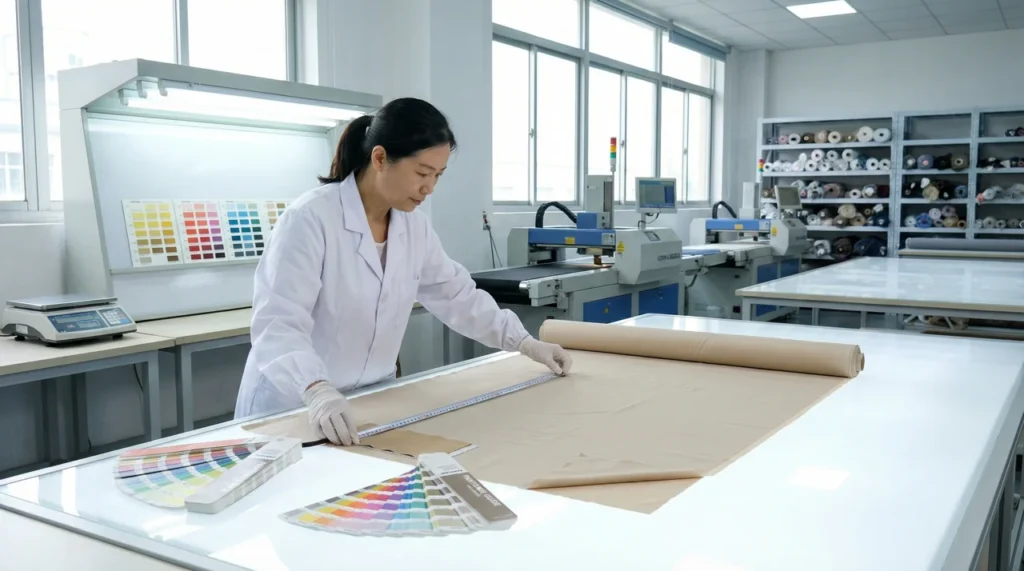
When: Before production begins, after raw materials arrive at the factory Purpose: Verify that all materials match your clothing tech pack specifications before a single cut is made
What Your Garment Inspection Checklist Should Cover:
- Fabric GSM weight matches tech pack specifications (learn about fabric GSM here)
- Color matches Pantone reference or approved lab dip
- Fabric surface defects (stains, holes, uneven dye penetration)
- Shrinkage test results documented
- All trims, buttons, and zippers are correct style, size, and quality
- Thread type and color verified
- Labels and packaging materials confirmed
Why It Matters: Discovering material problems before cutting prevents wasting labor and fabric on an entire run of defective goods. If the fabric is wrong, every garment in the production run will be wrong.
Cost: $200–400 for a standard pre-production inspection
2. During Production Inspection (DUPRO)
When: While production is ongoing, typically when 20–50% of the order is complete Purpose: Catch clothing manufacturing defects early — before the entire order is produced incorrectly
What to Check:
- First finished pieces verified against approved golden sample
- Work-in-progress garments evaluated at various sewing stages
- Stitch quality and construction consistency
- Measurement compliance on completed sections
- Worker technique and sewing consistency
Why It Matters: Early detection allows factories to correct problems before producing hundreds or thousands of defective units. Fixing 20 bad units costs dramatically less than reworking 2,000.
Cost: $200–400 for a standard DUPRO inspection
3. Pre-Shipment Inspection (PSI)
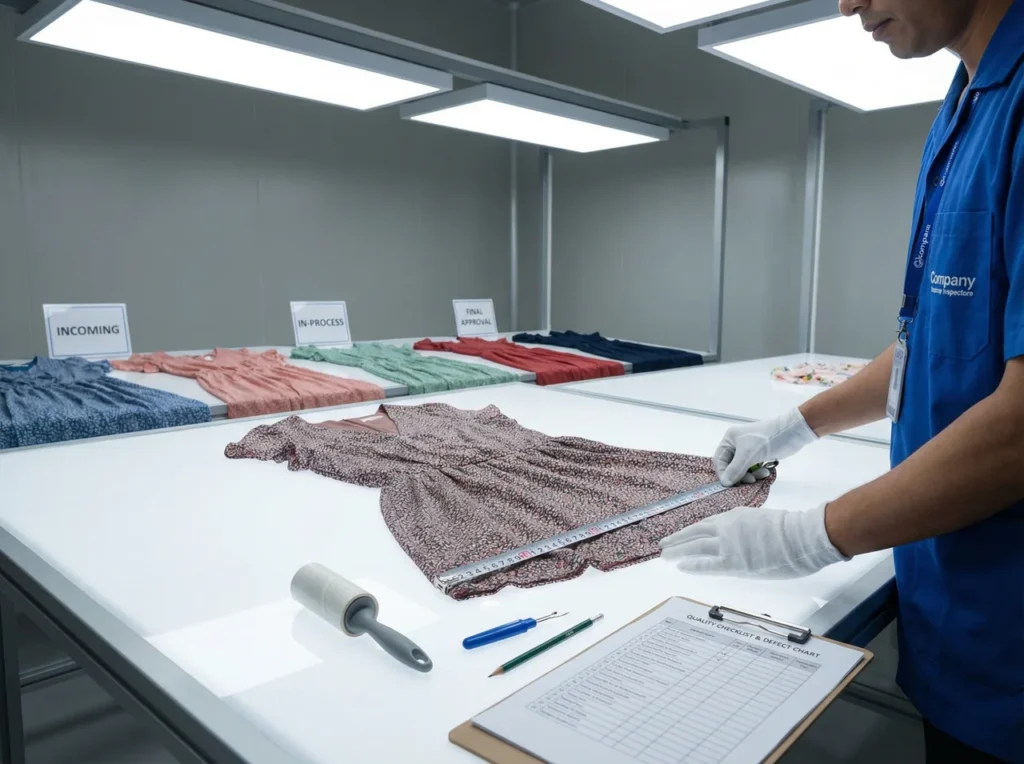
When: After production is 100% complete, before goods leave the factory Purpose: Final verification that finished products meet your clothing quality control standards before they ship
A pre-shipment inspection is the single most critical checkpoint in your entire clothing quality control process. This is your last opportunity to catch problems before goods enter the international shipping pipeline, where remediation becomes exponentially more expensive.
What Your Pre-Shipment Garment Inspection Checklist Must Cover:
- AQL-based random sampling (see next section)
- Complete workmanship assessment
- Systematic defect identification and classification
- Full measurement verification against tech pack
- Size run verification across all sizes
- Functionality testing (zippers, buttons, closures)
- Country of origin labeling compliance
- Hangtag and price ticket accuracy
- Packaging and polybag specifications
Cost: $200–500 depending on order size and factory location
4. Container Loading Check (CLC)
When: As finished goods are being loaded into shipping containers Purpose: Verify correct quantities are shipped and goods are protected during loading
What to Check:
- Carton quantities match shipping documents
- No water damage, crushing, or contamination
- Proper weight distribution and stacking in container
- Container is clean, dry, and structurally sound
- Container seal number recorded and documented
- Loading photographs taken for dispute protection
Cost: $150–300
Clothing Quality Control Inspection Timeline Summary
| Inspection Type | Timing | Cost | Priority |
|---|---|---|---|
| Pre-Production (PPI) | Before cutting | $200–400 | High |
| During Production (DUPRO) | 20–50% complete | $200–400 | High |
| Pre-Shipment (PSI) | 100% complete | $200–500 | Critical |
| Container Loading (CLC) | During loading | $150–300 | Medium |
Our Recommendation: Always conduct a pre-shipment inspection — on every order, from every factory, without exception. Add pre-production inspections for new factories or new materials. Use during-production inspections for large orders (1,000+ units) or complex styles. Container loading checks are optional but recommended for high-value shipments.
AQL Inspection Standards for Clothing Quality Control
AQL (Acceptable Quality Level) is the international statistical standard for determining how many defects are acceptable in a production batch. Understanding AQL inspection standards is essential for implementing objective, consistent clothing quality control that both you and your factory can reference without ambiguity.
How AQL Inspection Standards Work
Rather than inspecting every single garment (100% inspection), AQL uses statistical sampling based on ISO 2859-1 to evaluate quality efficiently:
- Determine your lot size (total order quantity)
- Choose your AQL level (typically 1.0, 1.5, 2.5, or 4.0)
- Consult AQL tables to determine required sample size
- Inspect the random sample and count defects by severity
- Compare defect count to accept/reject threshold
- Pass or fail the entire lot based on sample results
AQL Levels for Different Clothing Quality Control Standards
AQL 1.0 (Very Strict): Maximum 1% defective items acceptable. Used for premium brands, luxury goods, and high-value garments where any defect damages brand perception.
AQL 1.5 (Industry Standard): Maximum 1.5% defective items acceptable. Used by most consumer clothing brands and represents the balanced sweet spot between quality assurance and cost efficiency.
AQL 2.5 (Relaxed): Maximum 2.5% defective items acceptable. Used for budget brands, promotional items, and basic commodity garments.
AQL 4.0 (Very Relaxed): Maximum 4% defective items acceptable. Used only for very low-cost disposable fashion where quality expectations are minimal.
Defect Classification in Clothing Quality Control
AQL inspection standards classify defects into three severity categories:
Critical Defects (AQL 0 — Zero Tolerance):
- Safety hazards (sharp needle fragments, flammable non-compliant materials)
- Legal compliance failures (missing care labels, incorrect country of origin)
- Any critical defect results in automatic lot rejection
Major Defects (AQL 1.0–1.5):
- Significant functional problems (broken zipper, holes, major stains)
- Measurements exceeding tolerance
- Wrong color, wrong fabric, wrong construction
- Acceptance based on your chosen AQL level
Minor Defects (AQL 2.5–4.0):
- Cosmetic issues (loose threads, slight pilling, minor shade variation)
- Packaging imperfections
- Label placement slightly off-spec
- Acceptance based on your chosen AQL level
AQL Sampling Table Example
For a 1,000-unit order using standard AQL inspection standards:
| Defect Type | AQL Level | Sample Size | Maximum Defects to Pass |
|---|---|---|---|
| Critical | 0 | 80 units | 0 defects |
| Major | 1.5 | 80 units | 3 defects |
| Minor | 4.0 | 80 units | 7 defects |
An inspector randomly selects 80 garments. If the sample contains 0 critical defects, 3 or fewer major defects, and 7 or fewer minor defects — the lot passes. Exceeding any threshold triggers lot rejection.

Setting Your AQL Standards
Choose your AQL level based on these factors:
| Factor | Stricter AQL (1.0) | Standard AQL (1.5) | Relaxed AQL (2.5) |
|---|---|---|---|
| Price Point | Premium ($100+) | Mid-range ($30–100) | Budget (under $30) |
| Sales Channel | Online (customer can’t pre-inspect) | Mixed | Physical retail |
| Factory Relationship | New/unproven factory | Established partner | Long-term trusted partner |
| Product Type | Formalwear, luxury | Casual, everyday | Promotional, basics |
Our Recommendation for New Brands: Start with AQL 1.5 for major defects and AQL 4.0 for minor defects. This delivers good clothing quality control without excessive inspection costs. Adjust based on factory performance and customer feedback over time.
Clothing Quality Control Checklists by Garment Type
Different garment types require different inspection focus areas. Use these comprehensive garment inspection checklist templates during your clothing quality control inspections.
T-Shirts and Tops — Garment Inspection Checklist
Fabric Quality:
- Fabric GSM weight matches specification
- Color matches approved lab dip or Pantone reference
- No visible surface defects (holes, stains, dye marks, snags)
- Hand-feel matches approved sample
- Print quality (no cracking, fading, or misregistration)
Construction:
- All seams straight, even, and free of puckering
- Stitch density appropriate (10–12 stitches per inch for jersey)
- Hem is even and consistent width around entire garment
- Neckline lies flat without stretching or distortion
- Shoulder seams align symmetrically
Measurements:
- Chest, body length, sleeve length, shoulder width, neck opening all within spec tolerance
Trims and Finishing:
- Labels sewn securely with correct content and care information
- Prints and embroideries positioned per tech pack placement specs
Pants and Bottoms — Garment Inspection Checklist
Fabric Quality:
- Fabric weight, hand-feel, and drape match specification
- Color consistency throughout garment — no shading between panels
Construction:
- Waistband straight and lies flat
- Fly construction correct and functional (zipper or button)
- Pockets are even, properly positioned, and securely attached
- Inseam is straight without spiraling or twisting
- Hem is even on both legs
- Belt loops (if applicable) evenly spaced and secure
Measurements:
- Waist (relaxed and stretched), hip, inseam, outseam, thigh, leg opening, front rise, back rise
Hardware:
- Zipper operates smoothly in both directions
- All buttons secure and matching specification
- Rivets and hook/eye closures fully functional
Dresses — Garment Inspection Checklist
Fabric and Construction:
- Fabric drape appropriate for design silhouette
- Bodice and skirt align properly at waist seam
- Any gathering, pleating, or ruching is even and symmetrical
- Lining hangs properly without showing at any edge
- Hem is even around entire circumference
Measurements:
- Bust, waist, hip, total length, sleeve length, strap length
Outerwear and Jackets — Garment Inspection Checklist
Fabric and Construction:
- Shell fabric, lining, and interfacing all match specification
- Seams properly sealed or finished for weather resistance (if applicable)
- Collar lies flat and symmetrical
- Sleeves set correctly without puckering at armhole
- All pockets functional and properly positioned
Hardware:
- All zippers operate smoothly under load
- Buttons, snaps, and Velcro closures fully functional
- Drawstrings and cord hardware operate smoothly
- Insulation (if applicable) is evenly distributed with no clumping
Common Clothing Manufacturing Defects and How to Spot Them
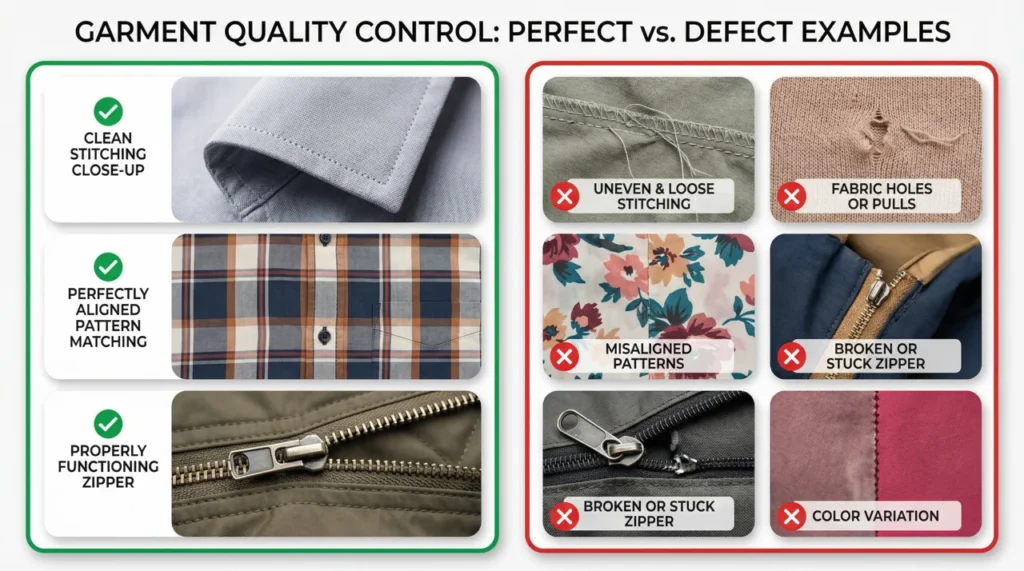
Knowing exactly what to look for is essential for effective clothing quality control. Here are the most common clothing manufacturing defects organized by category, with specific guidance on identification.
Fabric Defects
Color Variations (Shading): Different panels of the same garment display slightly different shades. Compare panels under consistent lighting and examine where seams join two pieces. Usually classified as a major defect.
Stains and Spots: Discolored areas from machine oil, handling, or chemical spills. Examine under strong lighting from multiple angles. Critical on light-colored garments.
Holes and Tears: Any break in fabric integrity — from needle damage, snagging, or machine malfunction. Gently stretch fabric to reveal tiny holes invisible when relaxed. Always a critical defect.
Pilling: Small fiber balls on fabric surface caused by low-quality yarn or friction during production. Run your hand across the surface and check high-friction areas. Minor if minimal; major if significant.
Construction Defects
Skipped Stitches: Gaps in stitch lines where the machine failed to catch the fabric. Follow seam lines visually and gently stress-test by pulling. Critical if the skip affects a structural seam.
Puckering: Fabric gathers or wrinkles along seam lines due to incorrect thread tension or needle issues. Lay the garment flat and examine each seam for smoothness.
Misaligned Seams: Seams that don’t match where they intersect — visible at side-seam-to-armhole junctions and shoulder points. Major defect if noticeable when garment is worn.
Uneven Hems: Hem width varies around the garment. Measure at multiple points and visually scan from distance.
Hardware and Trim Defects
Broken or Defective Zippers: Test each zipper up and down multiple times. Check for smooth operation, proper alignment, and secure stop at both ends. Always a critical clothing manufacturing defect.
Loose or Missing Buttons: Tug gently on every button. Check thread color and wrapping method. Critical if missing; major if loose.
Label Defects: Incorrect care information, misspelled brand name, upside-down application. Read every label line carefully. Critical if safety or legal content is wrong.
Measurement Defects
Out of Tolerance: Measurements exceed the acceptable range defined in your tech pack. Systematically measure every specification point and compare to your approved standards.
Twisted Garments: Side seams spiral around the body instead of hanging straight — common in knit t-shirts and leggings. Lay flat and verify grain lines are parallel to seams.
How to Handle Clothing Quality Control Failures with Factories
Discovering clothing manufacturing defects during inspection is stressful, but how you handle the situation determines whether your factory relationship survives and improves — or falls apart.
Immediate Response Protocol
Step 1: Document Everything. Photograph every defect type clearly. Record the number of affected units. Save the complete inspection report.
Step 2: Hold Shipment. Do not allow defective goods to ship. Once products leave the factory, your negotiating leverage drops dramatically.
Step 3: Categorize Issues. Classify each defect as critical, major, or minor. Determine whether the lot passes or fails your AQL inspection standards.
Communication Strategy
Be Specific, Not Emotional:
❌ “The quality is terrible. This is completely unacceptable!”
✅ “Inspection found 12 major defects in the 80-unit sample, exceeding our AQL 1.5 threshold. Specific issues include: [itemized list with photos and measurements]”
Always provide photographic evidence, reference your tech pack specifications, show comparison to approved sample, and propose specific solutions — not just problems.
Resolution Options for Clothing Quality Control Failures
| Option | Best For | Timeline | Cost Responsibility |
|---|---|---|---|
| Factory repairs | Minor, repairable clothing manufacturing defects | 1–2 weeks | Factory absorbs |
| Price discount | Minor defects, tight deadline | Immediate | Shared |
| Partial rejection | Mixed quality — some units pass, some fail | 2–4 weeks | Factory remakes rejects |
| Full rejection and remake | Widespread critical defects | Full lead time | Factory absorbs 100% |
| Third-party repair | Urgent timeline, factory unable to fix | 1–2 weeks | Typically shared |
Prevention for Future Orders
After resolving immediate clothing quality control failures, implement prevention measures:
- Root cause analysis: Determine why defects occurred — material quality, operator error, pattern issue, or specification misunderstanding
- Update tech pack: Revise unclear specifications and add “do not do” photo references showing specific clothing manufacturing defects to avoid
- Increase inspection frequency: Add DUPRO inspections for the next 2–3 orders from that factory
- Evaluate factory capability: If quality issues persist after 3+ production runs despite clear feedback, consider finding a new manufacturer
Free Clothing Quality Control Checklist Download
To help you implement professional clothing quality control immediately, we’ve created comprehensive inspection checklists covering every stage and garment type.
What’s Included:
✅ Pre-Production Inspection Checklist — Fabric verification, trim inspection, color matching
✅ During Production Inspection Checklist — Golden sample comparison, work-in-progress evaluation
✅ Pre-Shipment Inspection Checklist — AQL sampling, measurement verification, workmanship assessment, garment-specific checklists for tops, bottoms, dresses, outerwear, and knitwear
✅ Container Loading Checklist — Carton count, damage inspection, documentation
✅ Defect Classification Guide — Photo references for critical, major, and minor defects
✅ AQL Sampling Tables — Quick reference for common order quantities
How to Use These Clothing Quality Control Checklists:
- Print and laminate for durability during factory visits
- Use digitally on a tablet during inspections to integrate photos directly
- Customize by adding your brand-specific requirements
- Share with factories so they understand your standards before production begins
- Keep records of completed checklists for trend analysis and factory performance tracking
Download Links:
- [Complete QC Checklist Package (PDF)] — Printable version
- [Editable Excel Version (.xlsx)] — Customize for your brand
- [Mobile-Friendly Version] — Use on phone or tablet during factory inspections
Hiring Third-Party Clothing Quality Control Inspectors
While you can conduct inspections yourself, professional third-party inspection companies bring expertise, objectivity, and standardized reporting that significantly elevates your clothing quality control program.
When to Hire Third-Party Inspectors
Essential situations: First order with a new factory, large orders ($50,000+ value), complex or high-value products, you cannot visit China personally, or previous clothing manufacturing defects occurred.
Also beneficial: Limited in-house QC expertise, multiple simultaneous production runs, high-risk categories (childrenswear, technical outerwear), or when customers or retailers require inspection certificates.
Top Third-Party Clothing Quality Control Companies
| Company | Best For | Cost per Inspection | Specialty |
|---|---|---|---|
| QIMA | Small-to-mid brands, online booking | $200–400 | Asia-focused, excellent tech platform |
| SGS | Large brands, comprehensive services | $300–600 | Global leader, full lab testing |
| Bureau Veritas | Mid-to-large brands | $250–500 | Industry-specific expertise |
| Intertek | Large brands, compliance-focused | $300–600 | Comprehensive certification |
| InTouch Quality | Small brands, personalized service | $200–350 | China-focused, hands-on approach |
What to Expect from Professional Inspections
Standard Process:
- Booking: Schedule online or by phone (48–72 hours notice)
- Preparation: Inspector reviews your tech pack and AQL inspection standards
- Inspection Day: Inspector visits factory, conducts systematic examination
- Same-Day Update: Brief pass/fail notification within hours
- Detailed Report: Comprehensive report with photos within 24 hours
Inspection Report Contents:
- Executive summary (Pass / Fail / Pending)
- Workmanship assessment with severity ratings
- Measurement verification results per size
- Defect summary by type, quantity, and severity classification
- Digital photographs of all findings
- Inspector recommendations for resolution
ROI Calculation for Third-Party Clothing Quality Control
Investment: 15,000 Inspection as percentage of order: 2% Potential defect cost prevented: 12,500
Return on investment: 10–40× the inspection cost
FAQ: Clothing Quality Control Questions Answered
What is AQL in clothing quality control?
AQL (Acceptable Quality Level) is the international statistical standard — defined by ISO 2859-1 — used in clothing quality control to determine how many defective items are acceptable in a production batch. Instead of inspecting every garment, AQL uses randomized sampling to evaluate quality efficiently.
Most clothing brands use AQL 1.5 for major defects and AQL 4.0 for minor defects. For a 1,000-unit order, this means inspecting 80 randomly selected garments. If the sample contains 3 or fewer major defects, the lot passes. Finding 4+ major defects means the lot fails and requires rework or rejection.
How much does third-party clothing quality control inspection cost?
Standard pre-shipment inspection costs range from $200–500 per man-day, depending on the provider and factory location. One man-day typically covers 800–1,200 simple garments or 400–600 complex styles.
Example costs by order size:
- 500 units (simple style): ~$250
- 1,000 units (complex style): ~$350
- 3,000 units: ~$550
- 10,000 units: ~$900
Most inspection companies offer volume discounts: 10% off for 5-inspection packages, 15% off for 10-inspection packages.
When should I conduct clothing quality control inspections?
At minimum, conduct a pre-shipment inspection on every order — this is non-negotiable. Add pre-production inspections for new factories or new materials. Add during-production inspections (DUPRO) for orders over 1,000 units or styles with previous clothing manufacturing defects. Container loading checks are recommended for high-value shipments.
What if my factory fails a clothing quality control inspection?
Hold shipment immediately — do not allow defective goods to ship. Document all clothing manufacturing defects with photographs. Contact the factory with specific, factual findings (not emotional complaints). Agree on a resolution: factory repairs, partial rejection with rework, full rejection and remake, or price reduction. Implement prevention measures for future orders by updating your tech pack and increasing inspection frequency.
Can I do clothing quality control myself?
Yes — many small brands conduct their own inspections to manage costs. DIY clothing quality control works best for small orders (under 500 units), repeat orders from trusted factories, and simple garment styles. You’ll need a measuring tape, fabric scale, Pantone guide, camera for documentation, and your garment inspection checklist.
The limitation of DIY inspection is objectivity — your factory relationship may influence your judgment. For first orders with new factories, complex products, or large orders, hiring a third-party inspector provides the impartial, professional evaluation your clothing quality control program needs.
What’s the difference between QA and QC in clothing manufacturing?
Quality Assurance (QA) focuses on preventing defects through process design — establishing standards, training workers, and building systems that produce consistent quality. Quality Control (QC) focuses on detecting defects through inspection — examining finished or in-progress goods against those standards. Effective clothing quality control programs combine both: QA systems that prevent defects and QC inspections that catch anything the systems miss.
How do I find a reliable inspection company?
Search for inspection companies with specific apparel and textile expertise, ISO 17020 certification, and a physical presence in your factory’s manufacturing region. Start with one inspection to evaluate report quality, communication responsiveness, and practical usefulness of their recommendations. Top providers for clothing quality control include QIMA, SGS, and InTouch Quality.
Red flags to avoid: Prices significantly below market rate, refusal to provide sample reports or references, inspectors who pass every shipment, and reports that lack photographs or specific defect details.
Conclusion: Clothing Quality Control Is Your Brand’s Best Insurance
Implementing professional clothing quality control is not an expense — it’s the most cost-effective insurance your brand can buy. The frameworks, AQL inspection standards, garment inspection checklists, and defect identification strategies in this guide give you everything you need to establish a robust system that prevents clothing manufacturing defects from reaching your customers.
Remember: quality is not a one-time checkpoint but a continuous process of prevention, inspection, communication, and improvement. The brands that succeed long-term treat clothing quality control as non-negotiable from their very first production run.
Your clothing quality control journey starts now. Download our free checklists, establish your AQL standards, and make quality inspection an integral part of every manufacturing order. The investment you make today pays dividends in customer satisfaction, reduced returns, and brand reputation for years to come.
Need expert help with clothing quality control? Contact Algo Bert Fashion for professional inspection services, quality consulting, or factory recommendations. Our Guangzhou-based team has conducted thousands of inspections and can help you establish quality systems that protect your brand.
Get a free consultation → | Request a production quote →
Related Resources:
- Clothing Tech Pack Guide: 9 Essential Steps — Create specifications that prevent quality issues
- Fabric GSM Guide: Weight Selection Tips — Choose the right fabric weight for every garment
- How to Find Reliable Clothing Manufacturers in Guangzhou — Start with quality factories
- Sampling vs Bulk Production: What’s the Difference — Understand the production process
Ready to Bring Your Vision to Life?
Tell us about your project. We’ll recommend the best approach and provide a free, detailed quote.

 English (UK)
 Español
 Français
 Deutsch
 Português
 Italiano
 Polski
 Русский
 한국어
한국어