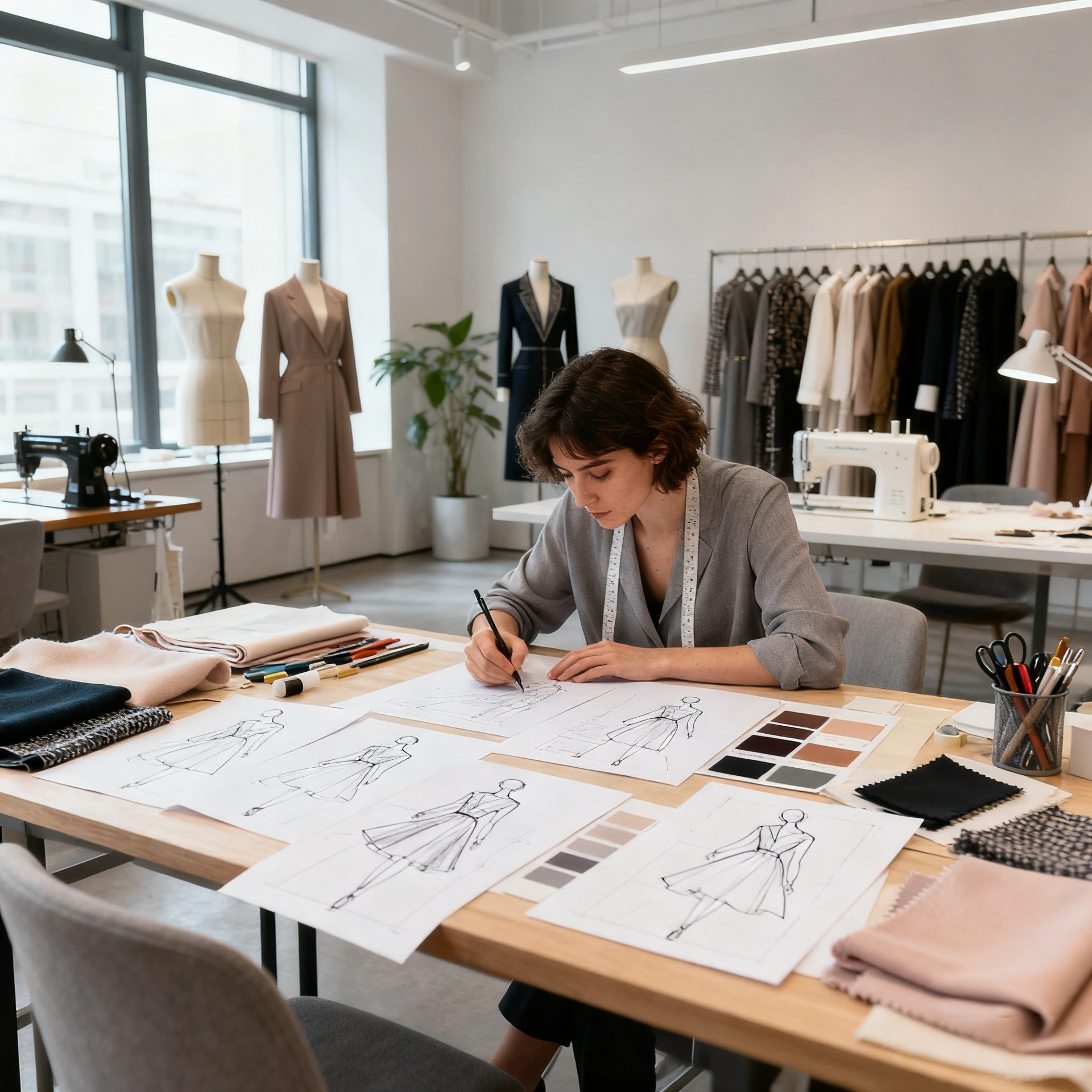
Dreaming of launching your own clothing brand but have no manufacturing experience? You’re not alone. But how to start a clothing brand?
Every year, thousands of entrepreneurs turn their fashion ideas into successful businesses – and many started exactly where you are now: with a vision, zero industry knowledge, and a lot of questions.
The good news? Starting a clothing brand has never been more accessible. With low MOQ (minimum order quantity) manufacturers, direct-to-consumer selling platforms, and global production partners ready to help, you don’t need a fashion degree or millions in funding to get started.
In this comprehensive guide, we’ll walk you through every step of starting a clothing brand from scratch – from developing your first designs to finding reliable manufacturers and launching your collection.
What you’ll learn:
- How to define your brand and find your niche
- Creating designs (even if you can’t draw)
- Finding the right manufacturing partner
- Understanding sampling and production
- Launching your first collection
- Common mistakes to avoid
Let’s turn your clothing brand dream into reality.
Table of Contents
Define Your Brand Identity
Before you design a single garment, you need to know what your brand stands for.
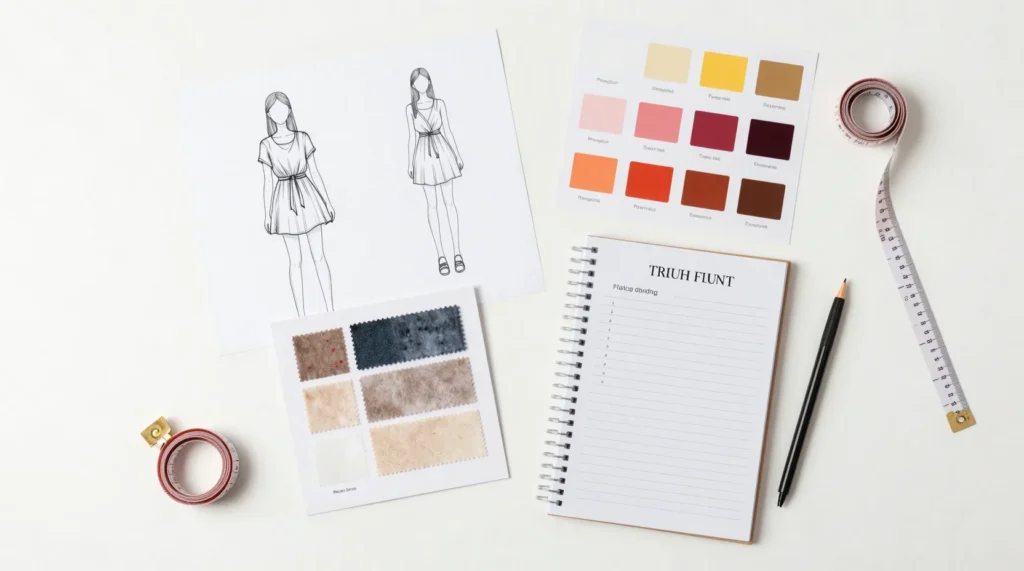
Ask Yourself These Questions:
Who is your ideal customer?
- What age group are you targeting?
- What’s their lifestyle and income level?
- Where do they currently shop?
- What problems do they have with existing clothing options?
What makes your brand different?
- Sustainable materials?
- Size inclusivity?
- Unique designs?
- Affordable luxury?
- Specific lifestyle focus (athleisure, workwear, streetwear)?
What’s your brand aesthetic?
- Minimalist and clean?
- Bold and colorful?
- Classic and timeless?
- Edgy and avant-garde?
Create Your Brand Foundation
Write down:
| Element | Your Answer |
|---|---|
| Brand Name | |
| Tagline | |
| Core Values (3-5) | |
| Target Customer | |
| Price Range | |
| Unique Selling Point |
Pro Tip: Look at 5-10 brands you admire. What do they do well? What gaps do they leave that your brand could fill?
Research Your Target Market
Skipping market research is one of the biggest mistakes new brand owners make.
Understand Your Competition
Study brands in your niche:
- What products do they offer?
- What are their price points?
- How do they market themselves?
- What do customers complain about in their reviews?
Validate Your Idea
Before investing in production:
- Survey potential customers – Use Instagram polls, Google Forms, or talk to people in your target demographic
- Check search demand – Use Google Trends to see if people are searching for products like yours
- Test with mockups – Create digital mockups and gauge interest before manufacturing
Calculate Your Pricing
Work backwards from retail price:
Retail Price: $50
├── Your Profit Margin (50%): $25
├── Marketing/Platform Fees (15%): $7.50
├── Shipping (10%): $5
└── Manufacturing Cost (25%): $12.50
Make sure your manufacturing partner can produce at a cost that allows profitable margins.
Create Your First Designs
You don’t need to be an artist to create clothing designs.
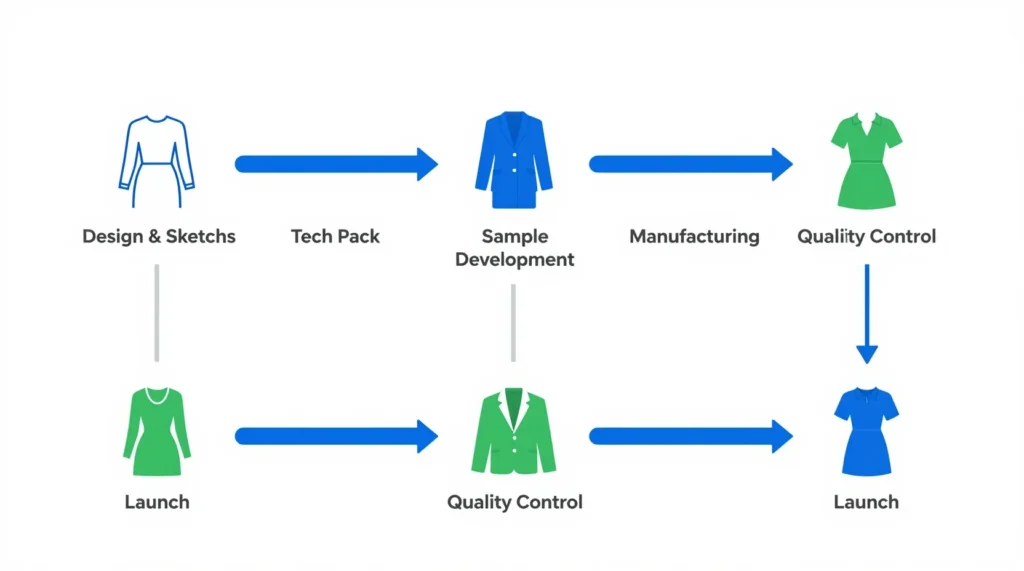
Option 1: Sketch It Yourself
Even rough sketches work. Manufacturers are experienced at interpreting basic drawings. Include:
- Front and back views
- Key design details
- Notes on fabric, color, and sizing
Option 2: Hire a Freelance Designer
Platforms to find designers:
- Fiverr
- Upwork
- 99designs
- Behance
Cost: $50-500 per design depending on complexity
Option 3: Work with Your Manufacturer
Many clothing manufacturers, including us at Algo Bert Fashion, offer design development services. Send us:
- Reference images (Pinterest boards, photos)
- Sketches (even hand-drawn)
- Description of what you want
Our team can help develop your concept into production-ready designs.
Create a Tech Pack
A tech pack is a detailed document that tells manufacturers exactly how to make your garment. It includes:
- Flat sketches (front, back, side views)
- Measurements for each size
- Fabric specifications
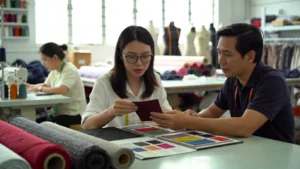
- Color information (Pantone codes if possible)
- Construction details (seam types, stitching)
- Labels and packaging requirements
Don’t have a tech pack? Many beginners don’t. A good manufacturing partner can help you create one based on your designs and reference samples.
Find a Manufacturing Partner
This is the most critical step. The right manufacturer can make your brand successful; the wrong one can destroy it.
Manufacturing Options
| Type | Description | Best For |
|---|---|---|
| Local Manufacturer | Produces in your country | Small batches, quick turnaround, premium pricing |
| Overseas Manufacturer (China, etc.) | Produces in Asia | Lower costs, higher MOQ, longer lead times |
| Print-on-Demand | Prints designs on blank garments | Testing designs, no inventory risk, lower margins |
Why China for Clothing Manufacturing?
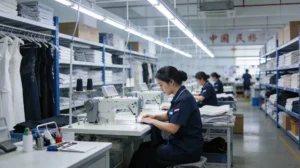
China, particularly Guangzhou, remains the world’s largest garment manufacturing hub because of:
- Skilled workforce – Generations of garment-making expertise
- Competitive pricing – Lower production costs
- Fabric access – Huge selection of materials
- Scalability – Can handle orders from 50 to 50,000 pieces
- Full-service options – Many manufacturers handle everything from design to shipping
What to Look for in a Manufacturer
✅ Experience with your product type – A t-shirt factory may not be ideal for formal dresses
✅ Low MOQ options – Essential for new brands (look for 50-100 piece minimums)
✅ Clear communication – Responsive, speaks your language, explains processes
✅ Sample quality – Always order samples before bulk production
✅ Transparent pricing – No hidden fees, clear quotes
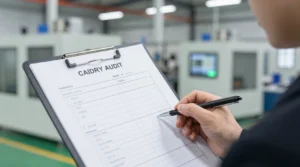
✅ Quality control process – Ask about their QC procedures
Red Flags to Avoid
❌ Prices that seem too good to be true
❌ No samples available before production
❌ Poor communication or slow responses
❌ No references or portfolio
❌ Reluctance to show factory or production process
❌ Demanding full payment upfront
How to Start the Conversation
When reaching out to manufacturers, include:
- Introduction to your brand
- Product types you want to manufacture
- Estimated quantities
- Target price point
- Timeline expectations
- Any reference images or sketches
Understand the Sampling Process
Never skip sampling. This is where you ensure your vision becomes reality.
Types of Samples
| Sample Type | Purpose | When to Use |
|---|---|---|
| Proto Sample | First attempt to see the design | Initial development |
| Fit Sample | Check sizing and fit | After proto approval |
| Pre-Production Sample | Final check before bulk | Before production starts |
| Top of Production (TOP) | Sample from actual production | Quality verification |
What to Check in Samples
- Fit and sizing – Does it fit your target measurements?
- Fabric quality – Is it what you specified?
- Construction – Are seams straight? Stitching consistent?
- Details – Buttons, zippers, labels correct?
- Color – Does it match your specifications?
Sample Costs
Expect to pay for samples. Typical costs:
- Simple t-shirt: $30-80
- Dress: $50-150
- Jacket: $80-200
Sample costs are usually credited toward your bulk order with many manufacturers.
Pro Tip: Order multiple sizes to check the grading (how the pattern scales across sizes).
Plan Your First Production Run
Start small. You can always reorder.
Recommended First Order Quantities
| Product Type | Suggested First Order |
|---|---|
| T-shirts | 50-100 pieces |
| Dresses | 50-100 pieces |
| Pants | 50-100 pieces |
| Outerwear | 30-50 pieces |
Size Distribution
A typical size ratio for first orders:
XS : S : M : L : XL
1 : 2 : 3 : 2 : 1
Example for 100 pieces:
XS: 11 | S: 22 | M: 34 | L: 22 | XL: 11
Adjust based on your target market research.
Production Timeline
Typical timeline from order to delivery:
Week 1-2:    Fabric sourcing
Week 2-4:    Production
Week 4-5:    Quality control & finishing
Week 5-6:    Shipping (sea freight)
             or Week 5 (air freight)
───────────────────────────────────────
Total:       5-6 weeks (air) or 7-10 weeks (sea)
Payment Terms
Common payment structures:
- 30% deposit, 70% before shipping – Most common
- 50% deposit, 50% before shipping – For new relationships
- Full payment upfront – Avoid if possible
Set Up Your Sales Channels
Where will you sell your clothing?
Online Options
| Platform | Pros | Cons |
|---|---|---|
| Shopify | Full control, professional, scalable | Monthly fees, need to drive own traffic |
| Etsy | Built-in audience, easy setup | Fees, crowded marketplace |
| Amazon | Huge audience | High fees, less brand control |
| Instagram/TikTok Shop | Direct social selling | Algorithm dependent |
Offline Options
- Pop-up shops
- Local boutiques (wholesale)
- Markets and fairs
- Trunk shows
Recommended Start
For most new brands:
- Shopify store – Your brand home base
- Instagram – Build community and brand awareness
- One marketplace (Etsy or Amazon) – Additional visibility
Launch and Market Your Brand
You’ve got products. Now you need customers.
Pre-Launch Checklist
- Professional product photography
- Website live and tested
- Social media accounts set up
- Email list started (even 50 people helps)
- Shipping and returns policy written
- Launch announcement ready
Marketing Strategies for New Brands
1. Social Media Content
- Behind-the-scenes of production
- Styling ideas
- Customer photos (UGC)
- Brand story content
2. Influencer Partnerships
- Start with micro-influencers (1,000-10,000 followers)
- Gift products in exchange for posts
- Track results before paying for larger influencers
3. Email Marketing
- Build your list from day one
- Send launch announcements
- Offer subscriber-only discounts
4. SEO and Content
- Blog about topics your customers care about
- Optimize product descriptions
- Build backlinks from fashion blogs
5. Paid Advertising
- Start with small budgets ($5-20/day)
- Test Facebook/Instagram ads
- Focus on retargeting website visitors
Common Mistakes to Avoid
Learn from others’ failures:
Mistake 1: Ordering Too Much Inventory
Problem: Ordering 1,000 pieces for your first run because the price per unit is lower.
Solution: Start with 50-100 pieces. Test the market. Reorder what sells.
Mistake 2: Skipping Samples
Problem: Going straight to bulk production to save time/money.
Solution: Always order samples. The cost of fixing a bad bulk order is much higher.
Mistake 3: Underpricing Your Products
Problem: Setting prices too low to compete, leaving no profit margin.
Solution: Calculate all costs (production, shipping, marketing, returns) and price for sustainable profit.
Mistake 4: Ignoring Quality Control
Problem: Assuming the manufacturer will catch all defects.
Solution: Have clear QC standards. Request inspection photos. Consider third-party inspection for large orders.
Mistake 5: Trying to Do Everything at Once
Problem: Launching 50 products in 10 categories for your first collection.
Solution: Start with 3-5 hero products. Master those, then expand.
Mistake 6: Choosing the Cheapest Manufacturer
Problem: Selecting a manufacturer based on price alone.
Solution: Balance cost with quality, communication, and reliability. The cheapest option often costs more in the long run.
How Algo Bert Fashion Can Help
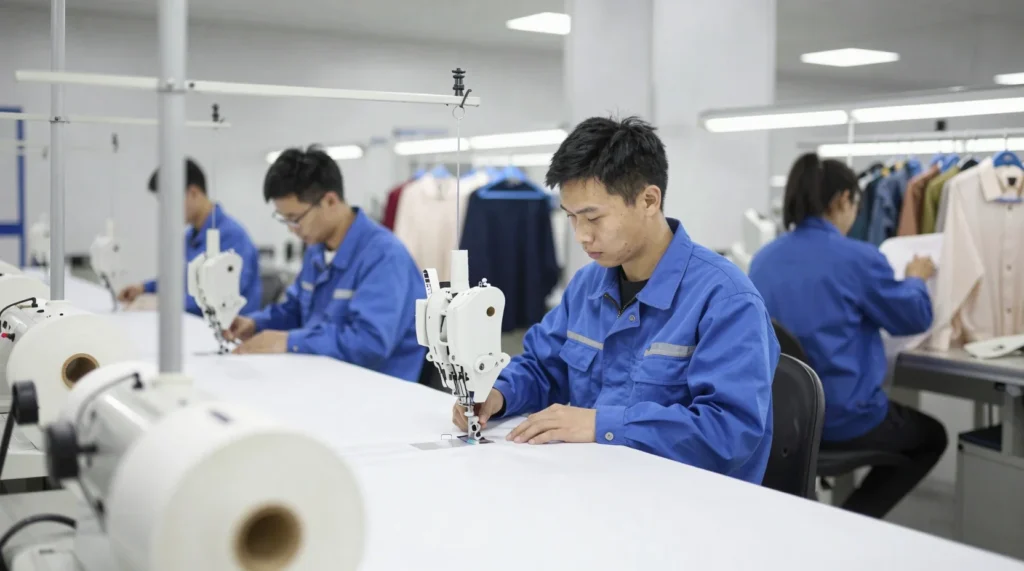
Starting a clothing brand is challenging, but you don’t have to do it alone.
At Algo Bert Fashion, we specialize in helping new and emerging brands bring their vision to life. Based in Guangzhou, China’s garment manufacturing capital, we offer:
✅ Low MOQ Production – Start with as few as 50 pieces
✅ End-to-End Service – From design development to delivered products
✅ Design Support – We can help develop your concepts into production-ready designs
✅ Quality Guaranteed – Rigorous QC at every stage
✅ Transparent Communication – Clear pricing, realistic timelines, regular updates
✅ Global Shipping – We deliver to brands in 50+ countries
Whether you have detailed tech packs or just a rough idea, our team is ready to guide you through the manufacturing process.
FAQ
How much money do I need to start a clothing brand?
A realistic starting budget is $2,000-10,000, covering:
- Samples: $200-500
- First production run: $1,500-5,000
- Branding and website: $200-1,000
- Marketing: $500-2,000
- Photography: $200-500
You can start smaller with print-on-demand, but custom manufacturing offers better margins and brand control.
What is MOQ and why does it matter?
MOQ stands for Minimum Order Quantity – the smallest number of pieces a manufacturer will produce per style. For new brands, low MOQ (50-100 pieces) is essential to minimize risk while testing the market.
How long does it take to produce clothing?
Typical production timeline is 3-5 weeks for manufacturing plus 1-3 weeks for shipping. Total time from order to delivery is usually 5-8 weeks. Rush orders may be possible at additional cost.
Do I need a fashion design background?
No. Many successful brand founders have no formal fashion education. What matters is understanding your customer, having a clear vision, and partnering with the right manufacturer who can help execute your ideas.
Should I manufacture locally or overseas?
Both have advantages:
- Local: Faster turnaround, easier communication, smaller minimums, but higher costs
- Overseas (China): Lower costs, larger capacity, access to diverse materials, but longer lead times
For most new brands, starting with a reliable overseas partner offers the best balance of quality and affordability.
How do I protect my designs?
Consider:
- Trademarking your brand name and logo
- Working with established, professional manufacturers
- Having clear contracts and NDAs
- Building unique brand value beyond just the designs
What if my first collection doesn’t sell?
It happens. Learn from it:
- Analyze what sold and what didn’t
- Get customer feedback
- Adjust designs, pricing, or marketing
- Start smaller next time
- Remember: most successful brands faced early failures
Start Your Clothing Brand Journey Today
You now have a roadmap to launch your clothing brand – even with zero experience.
The key is to start. Perfect is the enemy of done. Your first collection won’t be perfect, and that’s okay. Every successful fashion brand started with a first imperfect step.
Your next action:
- Define your brand identity
- Sketch or describe your first 3-5 products
- Reach out to a manufacturing partner
Ready to take the first step? Our team at Algo Bert Fashion is here to help you navigate the manufacturing process and bring your clothing brand to life.
Have questions about starting your clothing brand? Leave a comment below or contact our team directly. We’re happy to help!
Related Posts
- What is MOQ? Minimum Order Quantity Explained
- The Complete Guide to Clothing Manufacturing in China
- How Much Does It Cost to Start a Clothing Line?
 English (UK)
 Español
 Français
 Deutsch
 Português
 Italiano
 Polski
 Nederlands
 Svenska
 Русский
 Türkçe
 한국어
한국어